
What is an API? A plain-English guide for businesses
What is an API? A plain-English guide for businesses
You have probably seen the term API mentioned in conversations about websites, software, and digital tools — but if you have never had a clear explanation of what it actually is, you are not alone. It is one of those pieces of technology that most people encounter constantly without realising it, and one that businesses of almost every size and type depend on without necessarily knowing why.
This guide explains what an API is, how it works, why businesses use them, and walks through some of the most common everyday examples — from postcode lookups to payment processing — so that you can understand the role APIs play in the digital products and services you already use.
What is an API?
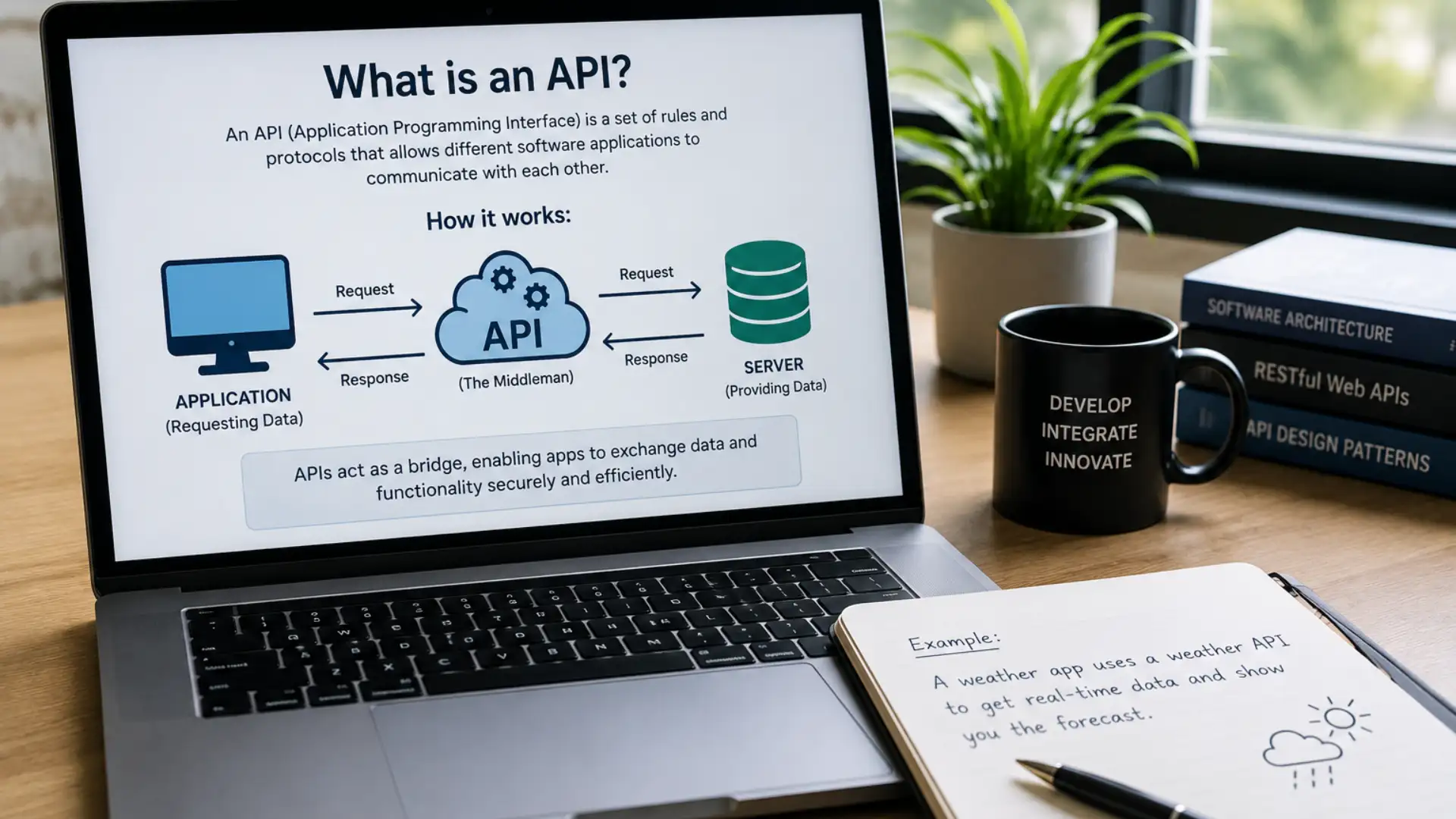
API stands for Application Programming Interface. It is a set of rules and protocols that allows two software applications to communicate with each other and exchange data, features, or functionality.
The best way to understand an API is through a simple analogy. Think of a restaurant. You sit at a table, and there is a menu in front of you. You do not walk into the kitchen and make your food yourself — instead, you tell the waiter what you want, the waiter goes to the kitchen, the kitchen prepares your order, and the waiter brings it back to you. You never need to know how the kitchen works. You just make a request and receive a response.
An API works in almost exactly the same way. One piece of software (your application, website, or tool) sends a request to another system via the API. The API passes that request on, the receiving system processes it, and the result comes back — all in a matter of milliseconds, and all without either system needing to know how the other is built internally.
💡 In short: An API is the messenger that takes a request from one application, delivers it to another system, and brings the result back — quickly, reliably, and securely.
How does an API actually work?
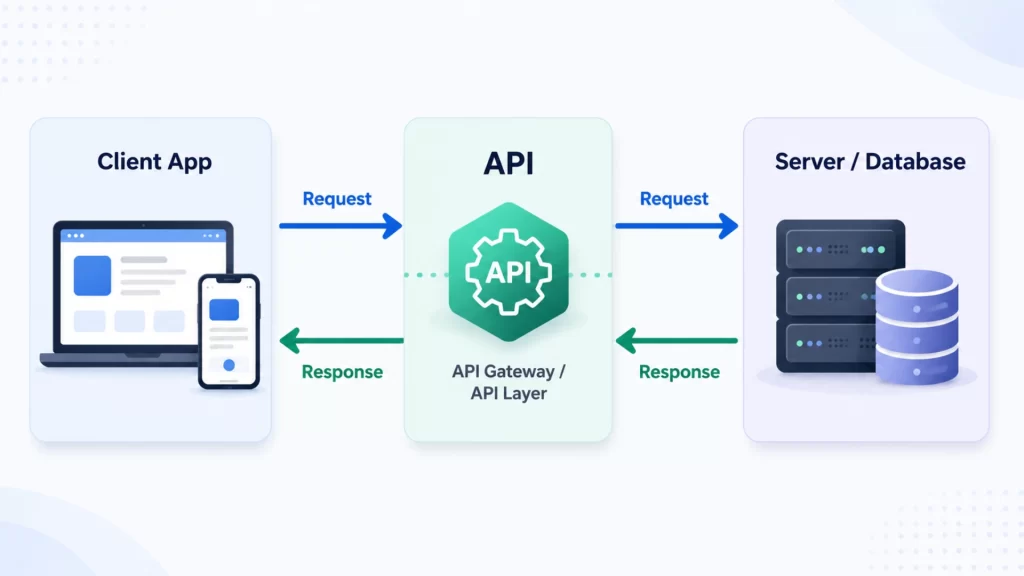
When an API is called, three things happen in sequence: a request is made, the request is processed, and a response is returned. These are sometimes called the client (the application making the request) and the server (the application or system providing the response). The API is the bridge between them.
Here is a concrete example. When you visit a website and click ‘Pay with PayPal’, you are triggering an API call. Your browser sends a request to PayPal’s systems via their API. PayPal processes the payment and returns a response to the website, confirming success or failure. The whole exchange happens behind the scenes — you see a confirmation message, but the technical handshake between the website and PayPal happened entirely through an API.
This request-and-response model — where one system asks, another answers, and neither needs to expose its full internal workings to the other — is what makes APIs so powerful and so widely used. They allow businesses to share specific pieces of data or functionality without opening up their entire infrastructure.
Why would a business use an API?
The short answer is that APIs allow businesses to add powerful functionality to their websites and software without having to build everything from scratch. Instead of creating your own mapping system, your own payment processor, or your own address database, you can connect to existing ones through their APIs and have them working on your site in hours rather than months.
For most businesses, this means faster development, lower costs, and access to capabilities that would be far too expensive or complex to build independently. A small e-commerce business can offer the same high-quality payment experience as a large retailer because both are connecting to the same payment provider’s API. A property website can display accurate maps of every listing because it is pulling from the same mapping data that powers widely used navigation tools.
Beyond adding functionality, APIs are also what allow different software tools to talk to each other. If your CRM, your email marketing platform, your accounting software, and your website all need to share customer data, APIs are what make that sharing automatic rather than manual. Without API integration, staff would be copying data between systems by hand — an approach that is slow, error-prone, and difficult to scale.
Key business reasons to use an API
- Save time and development cost by connecting to existing systems rather than building new ones
- Add functionality — payments, maps, postcode lookup, identity verification — that would be prohibitively complex to create independently
- Connect your business software so that data flows automatically between tools rather than being entered manually
- Improve the reliability and consistency of your data by pulling from authoritative sources in real time
- Build integrations with platforms your customers already use, such as payment providers, social media, or delivery networks
Common API examples that businesses use every day
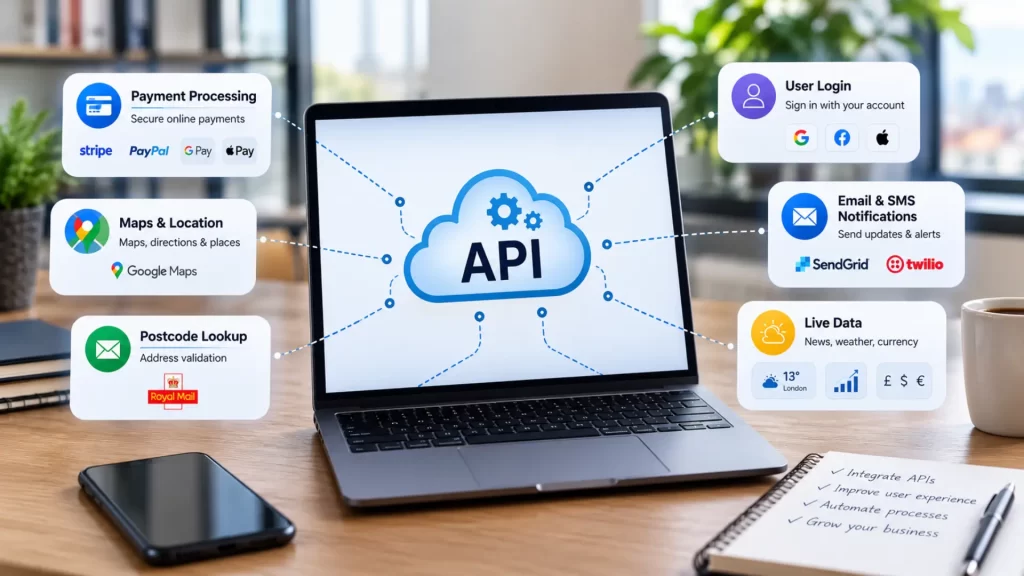
APIs are embedded in almost every digital experience. Here are some of the most common ones you will encounter — or may already be using — in a business context. If you are unsure how to integrate any of these into your own website or platform, our web development team can advise on the right approach.
Postcode lookup and address verification
When a user types their postcode into a form on your website and the address fields fill in automatically, that is an API at work. Postcode lookup APIs connect your website to address databases — the Royal Mail PAF (Postcode Address File) being the most widely used in the UK — and return structured address data instantly. This reduces errors in form submissions, speeds up the checkout process, and improves the quality of the data you hold on your customers.
Payment processing
Payment APIs are one of the most important integrations for any business that takes money online. Rather than handling card data yourself — which would require significant compliance infrastructure under PCI DSS — you connect to a payment provider’s API. Stripe, PayPal, and Worldpay are common examples. The payment provider handles the secure processing of card details, and your website simply sends and receives the relevant information through the API. The customer has a seamless checkout experience, and you never directly handle their card data.
Google Maps and location data
The Google Maps API allows businesses to embed interactive maps directly into their websites — showing store locations, delivery coverage areas, directions to an address, or distance calculations. Estate agents, restaurants, delivery businesses, and service companies with physical locations all use mapping APIs to help customers understand where they are and how to reach them. Integrating location features into a website is one of the most common API use cases we handle.
Login with Google, Facebook, or Apple
When a website offers the option to sign in using an existing account from a major platform rather than creating a new username and password, that is an authentication API — sometimes called OAuth or single sign-on. The user’s identity is verified by the platform they already trust, and the website receives confirmation without ever handling the user’s password. This reduces friction for users and the security burden on the website operator.
Email and SMS notifications
Email delivery services such as Mailgun, SendGrid, and Postmark, and SMS platforms such as Twilio, operate through APIs. Your website or business software sends an API call when a confirmation email or text message needs to go out — an order confirmation, a delivery update, a password reset — and the provider handles the actual delivery. This is far more reliable than sending emails from a generic web server and gives you detailed reporting on open rates and delivery success.
Currency exchange and financial data
For businesses that operate across currencies or need to display live pricing, currency conversion APIs provide real-time exchange rate data. Rather than manually updating rates, your website pulls the current figures from an API whenever a user requests a conversion. The same principle applies to stock prices, commodity prices, or any other financial data that needs to reflect real-world conditions in real time.
Delivery and shipping integrations
Courier and logistics APIs from companies such as Royal Mail, DPD, DHL, and others allow e-commerce businesses to generate shipping labels, book collections, and provide customers with live tracking information directly from their website. When a customer enters their order number and sees their parcel’s current location, that information is being pulled from the courier’s systems via an API.
Need to add API integrations to your website or platform?
Whether you need a postcode lookup, a payment gateway, a mapping feature, or something more bespoke, the Webphoria team builds API integrations into websites and web applications of all sizes. Get in touch to discuss your requirements and we will recommend the right approach.
APIs and AI: how they work together
APIs are also the mechanism through which artificial intelligence capabilities are added to websites and business tools. When a website has an AI chatbot, a content generation feature, or an automated response system, it is almost always using an AI model through an API. The website sends a request to the AI provider’s API — describing what it needs — and receives the AI’s output in response.
This is how AI chatbots on business websites work: the chatbot interface on your site communicates with an AI model via an API, sending the customer’s message and receiving a generated reply. The AI itself runs on the provider’s servers — your website simply connects to it through the API and displays the result. Similarly, AI automation workflows typically connect multiple systems together through APIs, passing data between them automatically without human intervention.
Understanding APIs makes AI integrations considerably less mysterious. The AI is a capability that lives somewhere else — you access it through an API, exactly as you would access a payment processor or a mapping service.
Does my business website need an API?
Not every website needs bespoke API integrations, but most business websites benefit from at least a few. If your website takes payments, it is using a payment API. If it has a contact form that sends an email confirmation, it is probably using an email delivery API. If it shows a map of your location, it is using a mapping API. APIs are already part of most business websites — the question is usually which additional ones would add the most value.
The most useful integrations to consider depend on your business type. For e-commerce businesses, postcode lookup, payment processing, and courier integrations are typically the highest priority. For service businesses, booking system integrations, CRM connections, and email automation are often more important. For businesses with multiple locations, mapping and store finder integrations add real value.
The key question is: what data or functionality would make your website more useful to customers or more efficient for your team? If the answer involves information or capabilities that already exist somewhere — in an address database, a payment network, a mapping service, or a business platform — there is almost certainly an API that can connect you to it. Our web development team works with a wide range of APIs and can advise on what is practical and cost-effective for your specific situation.
For a more technical overview of how APIs work and the different standards involved, the IBM Think guide to APIs provides a thorough reference for those who want to explore the technical detail further.
Ready to build smarter integrations into your website?
APIs are how modern websites connect to the tools, platforms, and data that make them genuinely useful. Whether you are looking to add a specific integration to an existing site or planning a new project that requires multiple connected systems, the Webphoria team can design and build the right solution from the ground up.
Get in touch and tell us what you need — we will give you a clear picture of what is possible and how to make it happen.