
Website redesign Manchester: when is it time to upgrade your site?
Website redesign Manchester: when is it time to upgrade your site?
Most business owners know, on some level, when their website has become a problem. The enquiries have dried up. The site looks like it was built for a different era. A team member mentions, slightly awkwardly, that a competitor’s site is considerably better. The question is never really whether a redesign is needed — it is whether the right moment has arrived, and what is involved in doing it properly.
This guide is for Manchester businesses thinking seriously about a website redesign. It covers the warning signs that a redesign is genuinely overdue, what the process involves, how to protect your search rankings during a rebuild, what you should realistically expect to pay, and how to choose the right agency to handle it. If you are weighing up whether now is the right time, this should give you a clear enough picture to decide.
How long does a business website actually last?
The honest answer is less long than most business owners assume. The average lifespan of a business website before a major redesign is needed is somewhere between two and a half and three years. That does not mean every site needs a full rebuild on that schedule — a well-maintained site with regular incremental improvements can last longer without feeling stale. But if your site has not been substantially updated in three or more years, and you are not actively monitoring its performance and making ongoing improvements, the likelihood is that it has fallen behind.
The pace of change in web standards makes this particularly relevant in 2026. What felt like a modern, well-built site in 2022 or 2023 may now be behind on Core Web Vitals performance, mobile experience expectations, and design conventions that visitors have come to take for granted. The gap between an up-to-date site and a dated one is increasingly visible to both users and search engines.
This does not mean you should redesign for the sake of it. A redesign that does not have clear objectives, that discards what is working alongside what is not, or that is executed without proper SEO management, can actively damage a business. The case for redesigning should be driven by evidence, not aesthetics alone.
Warning signs that your Manchester business website needs a redesign
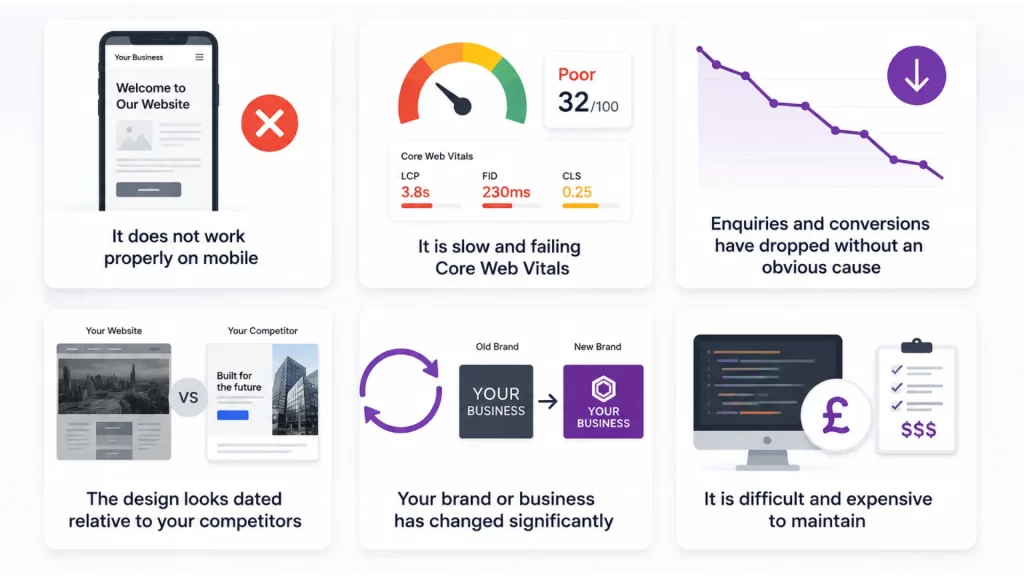
It does not work properly on mobile
Mobile devices now account for more than 70% of global web traffic. If your website does not display correctly on smartphones and tablets — if users have to pinch to zoom, if navigation is difficult on a small screen, or if forms are hard to complete without a keyboard — you are actively losing business from the majority of visitors. Google also uses mobile-first indexing, meaning it primarily evaluates the mobile version of your site when determining search rankings. A poor mobile experience hurts your position in local Manchester searches directly.
It is slow and failing Core Web Vitals
Page speed and Core Web Vitals — Google’s metrics for measuring how quickly and stably a page loads for real users — are direct ranking signals in 2026. If your site scores poorly on Largest Contentful Paint (LCP), Cumulative Layout Shift (CLS), or Interaction to Next Paint (INP), it is being penalised in search results relative to faster competitors. You can check your site’s current scores using Google’s PageSpeed Insights tool. A site built several years ago on a heavyweight theme or page builder, without performance optimisation, is very likely failing these benchmarks.
Enquiries and conversions have dropped without an obvious cause
If your site is still attracting traffic but generating fewer enquiries, leads, or sales than it used to, the problem is usually conversion rate rather than visibility. High bounce rates, low average session durations, and poor completion rates on contact forms or checkout flows all indicate that visitors are arriving but not doing what you need them to do. A redesign that focuses on user journey, calls to action, and conversion optimisation can have a more significant commercial impact than a purely aesthetic refresh.
The design looks dated relative to your competitors
Users make judgements about credibility within seconds of arriving on a site. If your website looks substantially older or less professional than those of your direct competitors, it communicates — unfairly but effectively — that your business may not be keeping pace. This is particularly important for service businesses where the website is often the first point of contact and the primary basis on which a potential customer decides whether to get in touch.
Your brand or business has changed significantly
If your business has rebranded, expanded its service offering, entered a new market, or significantly changed its positioning since the current site was built, the website may no longer accurately represent what you do or who you serve. A misaligned website creates friction — it generates enquiries from the wrong audiences or fails to convert the right ones — and it undermines any investment you have made in other marketing channels.
It is difficult and expensive to maintain
Technical debt accumulates on older websites. A site built on an outdated platform, dependent on poorly maintained plugins, or structured in a way that makes updates complex and time-consuming becomes progressively more expensive to maintain and increasingly risky to operate. If your team or your current agency is spending disproportionate effort on routine maintenance, or if making small content changes requires significant developer time, the underlying architecture may need to be rebuilt rather than patched.
What does a website redesign actually involve?
A website redesign is not simply a new coat of paint over the existing structure. A thorough redesign addresses the underlying architecture, user experience, content strategy, and technical performance of the site alongside its visual presentation. Here is what the process typically involves for a Manchester business website.
Discovery and strategy
A good redesign begins with understanding the current situation honestly. That means reviewing analytics to see which pages attract traffic and which do not, where visitors drop off, what conversion rates look like, and what search terms are currently driving visits. It also means understanding your business goals, your target audience, your competitive landscape, and what you need the new site to do differently. This phase typically takes two to three weeks and sets the parameters for everything that follows.
Information architecture and wireframing
Before any design work begins, the structure of the new site needs to be mapped out. Which pages will it contain? How will navigation work? What is the intended journey from landing page to conversion point? Wireframes — simplified structural layouts that show content placement without visual design — are the tool for getting this right before investing time in detailed design. Changing a wireframe costs a fraction of what it costs to change a finished design.
Design
The visual design phase translates the agreed structure into the actual appearance of the site — layout, typography, colour palette, imagery, and the visual treatment of individual components. A proper design process involves multiple rounds of feedback and refinement, not a single round of revisions. For businesses with an existing brand identity, the design should reflect and strengthen that identity. Where a rebrand is happening alongside the redesign, the two processes need to be coordinated carefully. Our web design team treats every project as a distinct brief rather than adapting a template.
Development and build
The approved design is built into a functioning website, with all the technical requirements implemented — responsive mobile behaviour, page speed optimisation, CMS configuration, contact forms and integrations, accessibility compliance, and any specific functionality the site requires. This phase is also where performance decisions are made: the choice of platform, the approach to images and scripts, and the hosting environment all have a material impact on how the finished site performs.
Content migration and SEO setup
Content from the existing site needs to be reviewed, updated where necessary, and migrated to the new structure. Crucially, any existing URLs that are changing need to be redirected properly — this is one of the most common points of failure in redesign projects and one of the most costly to get wrong. A properly managed SEO migration preserves existing rankings; a poorly managed one can wipe out years of organic search progress.
Testing and launch
Before going live, the new site is tested across devices and browsers, with particular attention to forms, integrations, and any dynamic functionality. Analytics tracking needs to be verified and — if you are migrating from a previous Analytics setup — continuity of historical data considered. The launch itself should be managed to minimise downtime and, where possible, should include a monitoring period immediately post-launch to catch any issues before they affect significant traffic.
How to protect your search rankings during a website redesign
This is the question Manchester businesses are most right to ask before committing to a redesign, and it deserves a direct answer. A well-managed redesign will not damage your search rankings. A poorly managed one can damage them significantly, and the recovery can take months.
The most important elements of SEO-safe redesign are these:
- Conduct a full URL audit before the redesign begins, documenting every page that exists on the current site and its current ranking position and traffic level
- Preserve URL structures wherever possible — if a page does not need to move, do not move it
- Implement 301 redirects from every old URL to the correct new URL for any page that is moving, consolidating, or being removed
- Migrate all existing meta titles, meta descriptions, and structured data, updating them where they need improvement rather than discarding them
- Ensure the new site’s crawlability and indexability are verified before launch — no pages accidentally blocked by robots.txt, no noindex tags left in place from development
- Monitor search rankings and organic traffic in the weeks immediately following launch and address any unexpected drops quickly
If you currently rank well for any search terms — locally in Manchester or more broadly — these rankings represent real business value and need to be protected throughout the redesign process. Working with an agency that treats SEO as an integral part of the build rather than an afterthought is the most effective way to ensure continuity.
Is your Manchester website due a redesign?
If you are seeing any of the warning signs above and want a clear picture of what a redesign would involve for your specific site, get in touch with the Webphoria team. We offer an honest initial assessment with no obligation.
How much does a website redesign in Manchester cost?
Website redesign costs vary significantly depending on the scope of the project, the complexity of the functionality required, and the level of design and content work involved. The following ranges are a realistic guide for Manchester businesses in 2026.
Entry-level redesign: £800 to £3,000
A straightforward redesign of a small business website — typically five to ten pages, no complex functionality, a clean modern design, and basic SEO setup — typically falls in this range. This assumes the client is providing all content and images. The result is a professionally designed, well-built site that performs correctly on mobile and meets current web standards.
Mid-range redesign: £3,000 to £6,000
For businesses with more pages, more complex functionality — booking systems, API integrations, e-commerce, member areas — or a need for substantial content production alongside the build, mid-range budgets cover a thorough, fully managed redesign. This is the range in which many growing SMEs in Greater Manchester tend to operate. It allows for a proper discovery phase, a thoughtful user experience process, and a development build designed for performance and longevity.
Larger or more complex redesigns: £6,000 and above
Larger business websites, multi-location or multi-language sites, platforms with significant custom functionality, or projects that include substantial brand work alongside the website design fall into this bracket. These projects typically involve more stakeholders, longer timelines, and more substantial content and technical requirements.
A professional website redesign that is properly planned and executed is an investment that pays back through improved conversion rates, better search visibility, and reduced maintenance costs. A redesign done cheaply, without a proper process, often creates new problems alongside the ones it was meant to solve.
Is your Manchester website due a redesign? A quick-check checklist
Your website probably needs a redesign if:
- It was last significantly updated more than three years ago
- It does not display or function correctly on mobile devices
- It scores below 70 on Google PageSpeed Insights for mobile
- Enquiries or leads from the site have declined without a clear explanation
- Your business, brand, or services have changed significantly since the site was built
- The design looks visibly dated compared to your main competitors
- Making content updates requires significant developer time or is frequently avoided because it is too difficult
- You have received comments from customers or prospects about the site being hard to use
For further background on what makes a strong redesign strategy, Hallam Agency’s guide to website redesign planning covers the strategic framework in useful detail.
What to look for in a Manchester website redesign agency
The agency you choose for a redesign has a direct impact on the outcome. A well-executed redesign with the right partner is a business asset; a poorly executed one creates ongoing problems. Here is what to look for.
- A defined process — the agency should have a clear methodology for discovery, design, build, and launch. Agencies that jump straight to design without a proper discovery phase are skipping the work that makes the end result actually fit your business.
- SEO capability built in — not bolted on. A redesign agency should be able to show you how they handle URL migrations, redirects, and ranking protection as standard, not as an optional extra.
- Relevant portfolio work — examples of redesigns for businesses of a similar size and type to yours, with evidence of performance improvements where possible.
- Honest scoping — an agency that asks detailed questions before quoting is doing it properly. One that gives a price within 24 hours of a first conversation has not thought hard enough about your specific project.
- Post-launch support — the launch is not the end. You should understand what support the agency provides after the new site goes live, and what ongoing maintenance or optimisation looks like.
Ready to talk about your website redesign?
Webphoria works with businesses across Manchester and the wider UK on website redesigns that are built around clear objectives, managed to protect SEO rankings, and delivered on realistic timelines. Whether you have a clear brief or you are still working out whether a redesign is the right move, we will give you an honest assessment and a clear picture of what is involved.
Get in touch to start the conversation.