
RankMath vs Yoast? Which plugin is best for SEO?
RankMath vs Yoast? Which plugin is best for SEO?
The RankMath vs Yoast debate is one of the most searched questions in the WordPress world — and for good reason. Your SEO plugin is the engine behind how well every page on your site performs in Google, and choosing the wrong one can mean months of missed opportunity.
Yoast SEO has been the dominant WordPress SEO plugin for well over a decade, with more than ten million active installations. RankMath launched in 2018 and has grown fast, pulling in over three million users with an aggressive free feature set that directly challenges what Yoast charges for. The honest answer to which is better depends on what your site actually needs — and this guide breaks it down feature by feature so you can make the right call.
We have used both plugins extensively across different types of WordPress sites. Here is what we found.
A quick snapshot: RankMath vs Yoast at a glance
Before diving into the detail, here is a side-by-side summary of how the two plugins compare across the areas that matter most.
| Feature | Rank Math | Yoast SEO |
|---|---|---|
| Free features | Schema, 404 monitor, redirects, local SEO, WooCommerce SEO | Basic meta, sitemap, readability — redirects & local SEO are paid add-ons |
| Readability | Combined with SEO score; basic feedback | Separate readability tab with Flesch–Kincaid; detailed tips |
| Schema markup | 16+ schema types in free version; test/validate tools included | Foundational schema; more limited free options |
| AI features | 40+ AI tools via Content AI (paid add-on from ~£48/yr) | AI title & meta generation + AI Optimize in Premium |
| Best suited to | Intermediate–advanced users; those who want more free features | Beginners and content-focused teams who prioritise readability |
RankMath vs Yoast: setup and ease of use
Both plugins walk you through a setup wizard when you first install them, but the experience is noticeably different. Yoast SEO’s five-step configuration process has a tendency to overwhelm new users — it surfaces a lot of technical settings early on that most beginners do not need immediately. The dashboard can feel cluttered, and the sheer volume of information thrown at you before you have even published a post is a common point of friction for those new to the WordPress SEO plugin space.
RankMath’s setup wizard is more guided and faster to get through. It offers two modes — Easy and Advanced — which is a thoughtful design choice. Easy mode gets a new site up and running with sensible defaults in minutes. Advanced mode surfaces the additional controls that more experienced users want access to from the start. As a result, RankMath tends to feel more welcoming for people at both ends of the experience spectrum when it comes to choosing an SEO plugin for WordPress.
Free features: where RankMath has a clear advantage
One of the most important practical differences in the RankMath vs Yoast comparison is what you actually get for free. RankMath’s free version is unusually generous. Out of the box, without paying a penny, you get:
- SEO titles and meta descriptions with a wide range of dynamic variables
- An XML sitemap generator covering all content types
- Schema markup with over 16 predefined types — including Article, Product, FAQ, HowTo, and more
- A built-in 404 error monitor to flag broken pages
- 301 and 302 redirect management directly from your WordPress dashboard
- Basic local SEO configuration
- WooCommerce SEO support for product pages
Yoast’s free WordPress SEO plugin covers the essentials — SEO meta fields, a sitemap, and readability checks — but several features that RankMath includes for free require paid add-ons with Yoast. Redirects, for example, are part of Yoast Premium. Local SEO requires a separate plugin at an additional annual cost. WooCommerce SEO is another paid extension. If budget is a consideration, RankMath’s free tier is difficult to argue against.
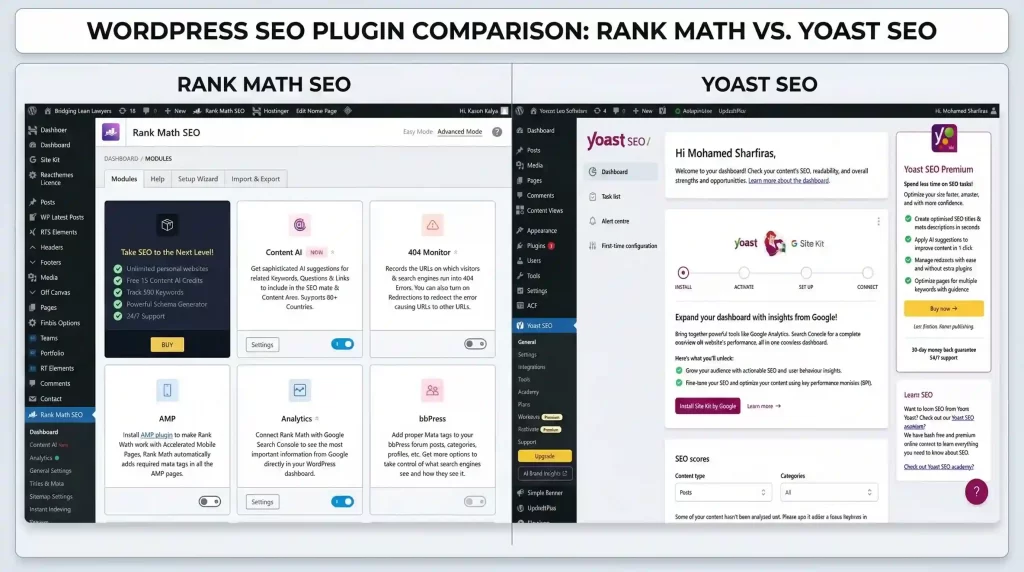
Readability analysis: Yoast does this better
This is the one area where Yoast consistently outperforms RankMath, and it is worth understanding why it matters. Yoast treats readability as a separate scoring category, giving it its own dedicated tab with a Flesch–Kincaid reading ease analysis. It checks sentence length, paragraph length, use of transition words, passive voice, and subheading distribution — and it gives you specific, actionable tips on what to improve and how. For content teams producing a high volume of articles, this real-time readability feedback is genuinely valuable.
RankMath, by comparison, folds readability into its overall SEO score rather than treating it separately. In the RankMath vs Yoast readability battle, the feedback RankMath provides is more limited — you get a score and some basic indicators, but the depth of guidance that Yoast offers to help you improve is simply not there in the same way. For sites where content quality and accessibility to a general readership are priorities, Yoast’s approach to readability is a meaningful differentiator.
Schema markup: the WordPress SEO plugin that goes further
Schema markup — the structured data that powers rich snippets in Google search results — is an area where RankMath has built a significant lead. In the RankMath vs Yoast schema comparison, RankMath’s free version supports over 16 predefined schema types, with an interface that is straightforward to use and includes tools to test and validate your markup directly from the plugin. This makes it genuinely easier to implement the kind of structured data that can earn your pages star ratings, FAQ dropdowns, and how-to steps in the search results.
Yoast’s free version provides foundational schema output that covers the basics, but the range of types available without upgrading is more limited. For sites where rich snippets have a meaningful impact on click-through rates — ecommerce stores, recipe blogs, review sites, service businesses — using RankMath as your SEO plugin for WordPress gives you a clearer path to implementing the structured data that makes those results possible.
Technical SEO tools: redirects, sitemaps and 404 monitoring
For developers and technically minded site owners, the RankMath vs Yoast comparison on technical SEO tools is relevant. RankMath includes a redirect manager in its free version that handles 301 and 302 redirects — the two you will need in the vast majority of situations when restructuring a site or changing URLs. It also includes a 404 monitor that logs broken page requests, making it straightforward to spot and fix errors before they affect your rankings.
Yoast’s redirect functionality is part of Premium, which means it is not available to free users at all. The sitemap generators in both plugins are capable and automatic, creating XML sitemaps for all your post types and keeping them updated as you publish. RankMath’s sitemap settings are spread across the modules page, which some users find less intuitive than having everything in one place. Yoast’s approach is simpler but less flexible in terms of which content types you can include or exclude.
AI features in both WordPress SEO plugins
Artificial intelligence has made its way into both plugins, though the two have taken different approaches. In the RankMath vs Yoast AI comparison, RankMath is the more ambitious of the two. Its Content AI module gives you access to over 40 AI tools and more than 125 prompt templates, covering everything from generating blog post outlines and introductions to bulk-producing meta titles and descriptions for existing pages. It is a comprehensive set of tools that can save significant time for sites with a large content library.
The catch is that Content AI is a paid add-on on top of the free or premium RankMath plan, starting at around £48 per year. If AI-assisted content is a key part of your workflow, you will need to factor in that additional cost when comparing the two as an SEO plugin for WordPress.
Yoast’s AI offering is more conservative. Its Premium plan includes AI-powered generation of SEO titles and meta descriptions, and an AI Optimize feature that suggests keyphrase-related edits within the WordPress block editor. It is useful but limited in scope compared to what RankMath’s Content AI can do. The advantage is that Yoast’s AI tools are included in the premium price with no separate add-on cost — so if you are already paying for Yoast Premium, you get everything that is currently available without paying more. For a WordPress SEO plugin that includes AI at a predictable cost, Yoast has an edge in value transparency.
Pricing: what does each plugin actually cost?
The pricing structure is a significant part of the RankMath vs Yoast decision for most businesses. RankMath’s free version is genuinely feature-rich — for many sites, it covers everything needed without any subscription at all. The Pro plan unlocks additional features including more advanced schema types, Content AI credits, and support for unlimited sites. Pricing starts at around £59 per year for a single site, though this varies and the Content AI add-on costs extra on top.
Yoast SEO Premium is priced per site, with the main premium plugin covering one installation. Individual add-ons for local SEO, WooCommerce, news sitemaps, and video sitemaps each carry their own annual cost, which means the total can escalate quickly if you need multiple features across a multi-purpose site. Yoast does offer bundles to reduce this, but the cost structure requires more careful calculation than RankMath’s more straightforward tiering.
RankMath vs Yoast: our honest verdict
After testing both plugins across different types of WordPress sites, the RankMath vs Yoast comparison does not have a single universal winner — but it does have a clear answer for most situations.
Choose RankMath if: you want the most feature-rich free SEO plugin for WordPress, you need schema markup, redirects, or a 404 monitor without paying for extras, you manage multiple sites, or you want access to advanced AI content tools and are happy to pay a modest additional cost for them. RankMath gives you more out of the box, scales better with technical needs, and offers stronger value at every price point.
Choose Yoast SEO if: you are newer to WordPress or SEO and want a simpler, more familiar interface with strong readability guidance, you are managing a content-heavy site where Flesch–Kincaid scores and detailed writing feedback matter, or your team values the trust and track record of an established, long-running plugin. Yoast’s readability tools remain genuinely best-in-class, and its Premium AI features are included at no extra cost.
For most businesses — particularly those building or growing a commercial WordPress site — RankMath is the stronger choice in 2025. Its free WordPress SEO plugin covers ground that would cost money elsewhere, and its technical tools give you more control without demanding a larger budget. Yoast remains excellent, but it has been playing catch-up on features that RankMath made available for free from the start.
If you are not sure which SEO plugin for WordPress is right for your specific site, or if you are looking for expert guidance on your broader SEO strategy, the Webphoria team works with businesses across the UK to build websites that perform well in search — from the platform and plugin choices through to the content and technical setup that underpin long-term rankings.
Not sure whether RankMath or Yoast is right for your site?
Choosing the right WordPress SEO plugin affects everything from rankings to content performance. RankMath offers more advanced features for free, while Yoast focuses on readability and ease of use — and the right choice depends on your site, goals, and workflow. Our team can help you choose, set up, and optimise your SEO stack for long-term results.