
Why your website isn’t showing up on Google — and what a local SEO audit actually reveals
Why your website isn’t showing up on Google — and what a local SEO audit actually reveals
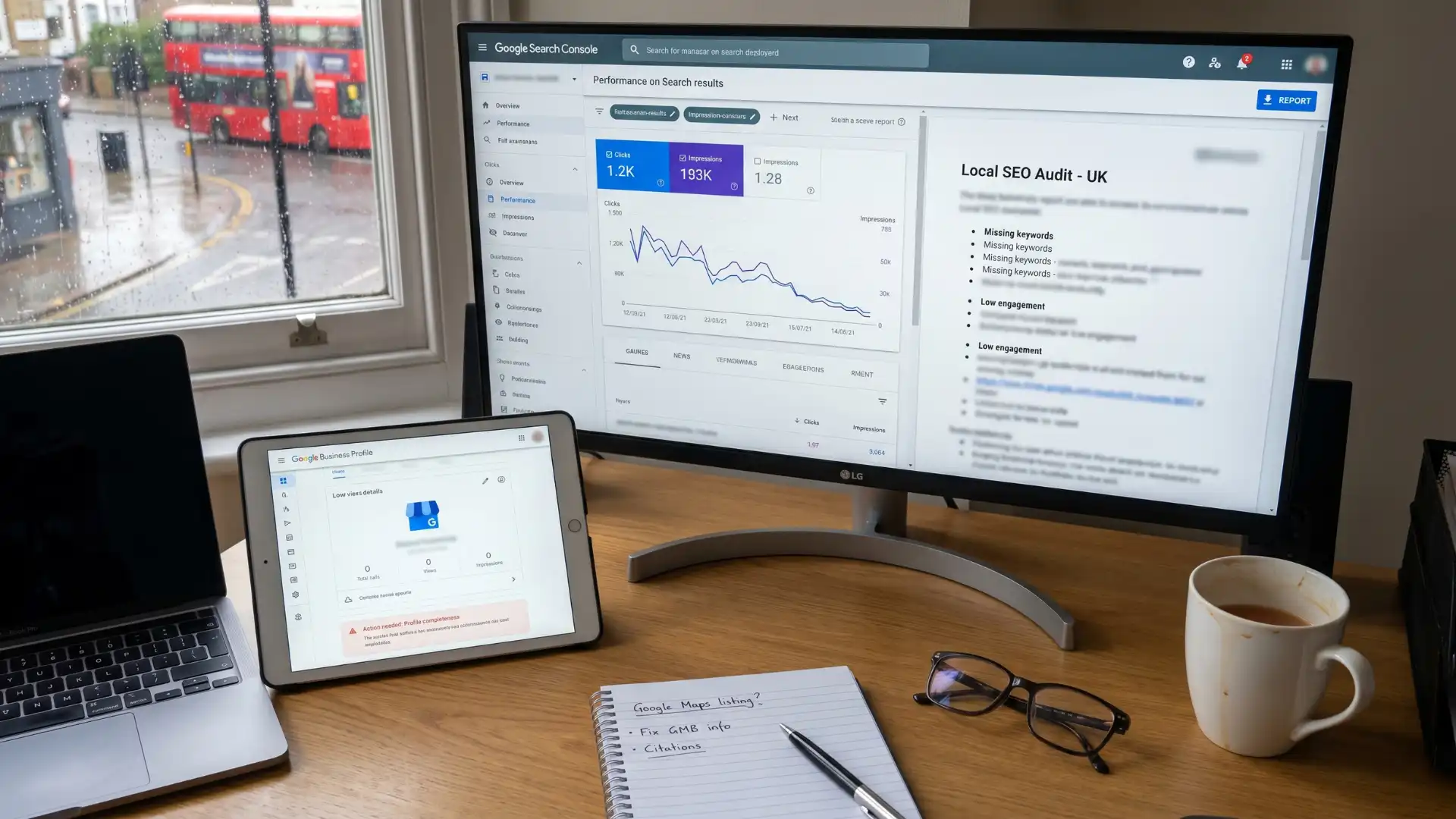
The question “why is my website not showing on Google?” is one of the most common and most frustrating problems facing UK businesses in 2026. You have a website. You invested time and money in it. Your competitors appear in search results. You do not. Something is wrong — but what exactly?
A local SEO audit answers that question systematically. Rather than guessing at one or two possible causes, an audit examines every layer of your digital presence: how Google perceives your site technically, whether your content matches what local customers actually search for, whether your Google Business Profile is working in your favour, and whether your competitors are simply out-executing you on factors you have not considered.
This article explains the most common reasons a website is not showing on Google, what a local SEO audit specifically looks at, and which findings are most likely to be holding your business back right now.
The first thing to check: has Google actually indexed your site?
Before investigating anything else, confirm whether Google has indexed your website at all. Open Google and type site:yourdomain.co.uk — replacing the example with your actual domain. If pages from your site appear in the results, Google knows your site exists but is not ranking it well enough to be visible. If nothing appears, Google has not indexed your site, which is a more fundamental problem and the starting point for any fix.
A site that has never been indexed is essentially invisible not because it is penalised or low quality, but because Google has not yet added it to its database of pages. This happens to new websites that have not been submitted to Google Search Console, websites whose robots.txt file accidentally blocks crawlers, and websites with a “noindex” tag left in place from development.
The most direct remedy is to set up Google Search Console, submit your XML sitemap, and use the URL Inspection tool to request indexing of key pages. This is free, takes under an hour, and is the single most impactful quick fix for a site that has never appeared in search results.
Seven reasons your website isn’t showing on Google
If your site is indexed but still failing to appear for searches that matter to your business, one or more of the following factors is almost always responsible.
Your site has a technical barrier Google cannot get past
Technical problems are the silent killers of search visibility. A robots.txt file that blocks crawlers, a server that times out frequently, redirect chains that confuse Google’s navigation of your site, or JavaScript-heavy pages that take too long to render — all of these prevent Google from properly accessing and understanding your content even when the pages themselves are well-written and relevant.
Page speed is a specific technical factor that carries direct ranking weight. If your website takes more than three to four seconds to load on a standard mobile connection, Google’s systems will suppress its visibility — particularly for local searches where over 89% of queries in 2026 originate on mobile devices. A local SEO audit will always include a technical crawl that identifies these issues explicitly.
Your content does not match how people actually search
Your website might describe your services in professional, accurate language that completely fails to match what your customers type into Google. If you are a plumber in Derby who only ever refers to “domestic heating and water services” on your website, Google will not connect your pages with searches for “plumber Derby” or “emergency plumber near me.” The gap between industry terminology and plain-language customer searches is one of the most common causes of low visibility for service businesses.
Your location matters just as much as your service description. If the city, town, or area you serve is not mentioned naturally and consistently across your key pages — in headings, body copy, page titles, and meta descriptions — Google has no reliable signal that you are relevant for local searches in that area.
Your Google Business Profile is incomplete, unverified, or out of date
For local search results — the map pack that appears at the top of Google when someone searches for a service near them — the Google Business Profile is the single most influential factor. A business that appears in the map pack without ranking anywhere in the organic results below it can still capture the majority of clicks from that search.
A local SEO audit consistently finds the same Google Business Profile problems: accounts that were created but never fully verified, business hours that have not been updated, primary categories that do not match the business’s actual main service, and profiles with fewer than five reviews competing against local competitors who have accumulated 50 or more recent, high-quality ones. Any one of these issues can explain why a business fails to appear in local map results even for searches where they clearly should.
Your NAP data is inconsistent across the web
NAP stands for Name, Address, and Phone — the three core data points that Google uses to verify a local business’s identity and location. When these details appear differently across your website, your Google Business Profile, and local directories — different phone formats, abbreviated street addresses in some places, old addresses that were never updated — Google’s confidence in your business’s legitimacy drops, and so does your local ranking.
A local SEO audit traces your NAP data across every directory and citation where your business appears and flags every inconsistency. This is painstaking work to do manually but automated audit tools surface these discrepancies quickly and with enough detail to prioritise which ones to fix first.
You are targeting keywords your site cannot yet compete for
A new or low-authority website attempting to rank for generic, high-volume terms — “solicitor,” “dentist,” “web designer” — is competing against established businesses with years of accumulated links, reviews, and content depth. It is not that your site is doing anything wrong; it is that the sites on page one have significantly more trust signals built up over time.
The practical fix is to start with longer, more specific searches — “web designer Nottingham for small businesses,” for example — that have lower competition and clearer local intent. Ranking for these builds authority and visibility that over time allows you to compete for broader terms. A local SEO audit will identify which terms are realistically winnable in the short term versus which will require a sustained long-term strategy.
Google has penalised your site
Penalties are less common than business owners fear, but they do happen. A manual action penalty — issued by a Google reviewer — appears directly in Google Search Console with an explanation of what triggered it. Algorithmic penalties, where Google’s automated systems suppress a site because of past practices, are less obvious and require analysis of traffic patterns alongside technical review.
The most common penalty triggers include buying links from low-quality directories, publishing content that was copied from other websites, keyword stuffing in page titles and body copy, and participating in link exchange schemes. If a site that previously appeared on Google has suddenly dropped out of results, a penalty investigation should be the first step, not the last.
Your competitors are simply doing it better
Sometimes the honest answer to “why is my website not showing on Google?” is that your competitors’ websites are better optimised, better linked, better reviewed, and more active than yours. They have more pages covering more relevant local topics, their Google Business Profiles are consistently updated, their customers leave reviews that mention specific services and locations, and their sites are faster and more reliable.
This is not a discouraging finding — it is an actionable one. Understanding the specific gap between where you are and where your top-ranking competitors are is one of the most useful outputs of a local SEO audit, because it translates directly into a prioritised list of improvements.
What a local SEO audit examines — the full checklist
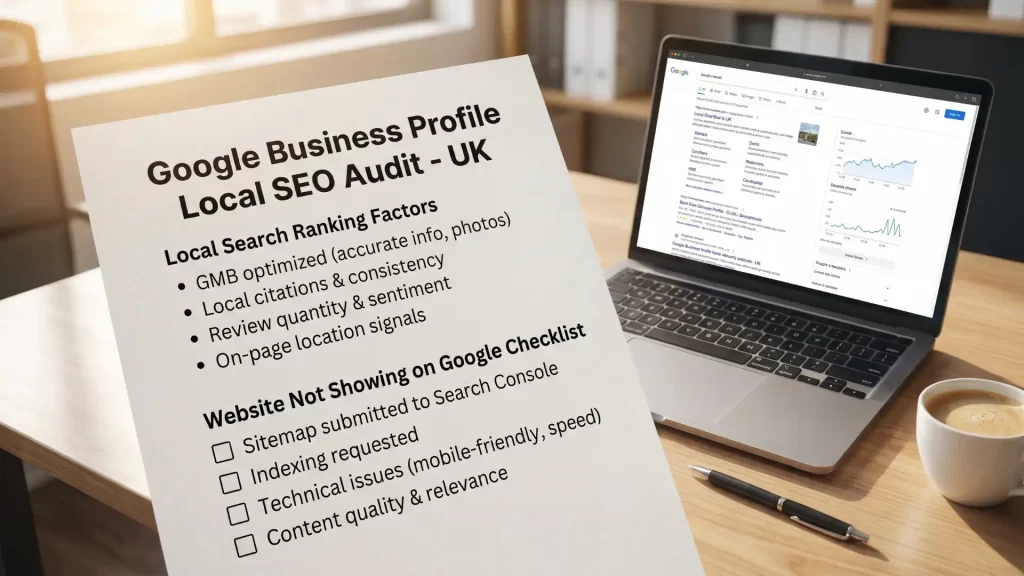
A thorough local SEO audit is not a single scan. It is a systematic review across multiple layers of your digital presence, each of which can independently suppress your visibility in local search results.
- Technical crawl and indexing check: confirms which pages are indexed, identifies crawl errors, flags redirect issues, checks robots.txt and noindex directives, assesses page speed on both desktop and mobile
- Google Business Profile review: verifies completeness and accuracy of your GBP listing, checks category selection, assesses review volume and recency, reviews post activity and photo quality
- NAP consistency audit: checks your business name, address, and phone number across your website, GBP, and major directory citations for inconsistencies
- Local keyword gap analysis: identifies the location-based and service-based search terms your potential customers are using that your website is not currently targeting
- On-page optimisation review: examines page titles, meta descriptions, H1 headings, and body copy across key pages for keyword inclusion, geographic signals, and search intent alignment
- Backlink profile assessment: reviews the quantity and quality of websites linking to yours, identifies toxic or low-quality links, benchmarks against local competitors
- Review and reputation audit: compares your review volume, rating, and recency against the businesses currently ranking in your local map pack
What the audit almost always finds: the most common local SEO problems in the UK
After reviewing many UK business websites, the same problems surface repeatedly. Understanding them before you commission an audit helps you set the right expectations about what is likely to come back.
The single most common finding is a Google Business Profile that is either partially set up, categorised incorrectly, or has seen no activity for months. A business with 4 reviews on a GBP listing competing against a competitor with 47 reviews and active weekly posts is not losing on technical grounds — they are losing on signal volume.
The second most common finding is a website that has never been structured with local search in mind. Service pages use generic descriptions with no location mentions. There is no town or city name in the title tags of key pages. The content would be identical whether the business served Manchester or Melbourne. Google, which processes billions of location-specific searches every day, has no reason to believe this business is relevant for searches in a specific area.
Technical issues — slow load times, non-mobile-friendly layouts, and broken internal links — are found in the majority of older UK business websites, particularly those that were built before Google’s Core Web Vitals became ranking factors. Mobile performance is no longer optional. With the overwhelming majority of local searches happening on phones, a site that performs poorly on mobile is being actively suppressed. Our article on whether a mobile app is actually what your business needs, or whether a better website would do more is worth reading alongside this for context on how mobile performance connects to your wider digital strategy.
When the problem is your website itself
A local SEO audit can find issues that a content strategy, a GBP update, or a link-building effort cannot fix. If the website itself is technically unsound — a theme that produces bloated code, a hosting environment that delivers slow server response times, a structure that prevents Google from crawling key pages — the solution is not more blog posts or more citations. The solution is a better website.
This distinction matters because businesses sometimes invest months in content and local SEO activity built on a website that will never rank well regardless of the effort applied on top of it. An audit that surfaces structural or performance issues at the website level is delivering the most honest and commercially important finding it can.
A website built with clear page structure, fast load times, mobile-first performance, correctly formatted title tags, clean internal linking, and locally relevant content gives every other SEO effort something solid to build on. Our conversion-focused web design service is built around exactly these principles — sites designed not just to look professional, but to give Google clear, reliable signals about who the business is, what it offers, and where it operates.
After the audit: what to fix first and in what order
Not every finding in a local SEO audit is equally urgent. Some issues directly block Google from indexing your content and must be fixed before anything else will have any effect. Others are competitive advantages that will improve your position over time but are not causing active suppression.
The correct sequence is:
- Fix indexing and crawl barriers first. txt blocks, noindex tags, redirect errors, and sitemap problems are the gating issues. Nothing else matters until Google can reliably access your pages.
- Resolve technical performance issues. Page speed, mobile rendering, Core Web Vitals. These have direct ranking impact and affect every page on the site simultaneously.
- Correct and complete your Google Business Profile. Ensure the primary category is correct, all details are accurate, photos are current, and a process is in place for encouraging customer reviews consistently.
- Fix NAP inconsistencies. Standardise your business name, address, and phone format across your website and all major directories.
- Address on-page content gaps. Add location signals to page titles and key pages, create dedicated service-area content where it is missing, and align your copy with the actual search terms your customers use.
- Build authority over time. Earn links from relevant local sources — press mentions, business associations, local directories — and maintain active review generation as a permanent business process.
The audit is only useful if the findings are acted on
A local SEO audit produces a list of problems. The value it delivers depends entirely on whether those problems are addressed in a systematic way — and whether the business has the right support to implement the fixes correctly.
Some findings are easy to act on immediately: updating a Google Business Profile, correcting a phone number on a directory listing, removing a noindex tag. Others — rebuilding a site’s page structure, improving page speed, creating new service-area content — require more sustained effort and often external expertise.
Ongoing monitoring matters too. A website is not a one-time project. Google’s algorithm updates, changes in local competitor activity, and the accumulation of new reviews and content all shift the competitive landscape continuously. The businesses that maintain strong local search visibility are the ones treating their digital presence as an asset that requires regular attention, not a box that was ticked at launch. Our guide to what actually needs to happen after your website goes live covers the ongoing performance, maintenance, and growth activity that website owners consistently underestimate.
Visibility without conversion is only half the problem
A local SEO audit focuses on why your website is not showing on Google — but it is worth keeping the bigger picture in view. Appearing on Google is the entry point. What happens when someone arrives on your site determines whether that visibility translates into enquiries, leads, and customers.
A site that ranks well but loads slowly, communicates its services unclearly, provides no obvious way to make contact, and fails to capture leads from visitors who are not yet ready to call is not serving the business effectively. Getting more traffic to a site that converts poorly produces limited results.
The combination of strong local visibility and a website that actively converts visitors is what produces a measurable impact on revenue. Automating the follow-up with those leads — ensuring that every enquiry is responded to, tracked, and nurtured — closes the loop. Our AI chatbot solutions are one example of how businesses can ensure that the visibility work done to bring people to their site is not undermined by slow or inconsistent response to the enquiries that arrive.
Start with an honest assessment of where your website actually stands
If your website is not showing on Google for the searches that matter to your business, you are losing customers to competitors who appear where you do not. The size of that loss is easy to underestimate — most of those potential customers never know your business exists, and the enquiries you miss leave no visible trace.
A local SEO audit removes the guesswork. It tells you specifically which of the many possible reasons apply to your website, in what order they should be addressed, and which of them require a fundamental improvement to your digital foundation rather than a surface-level fix applied on top of a structural problem.
At Webphoria, we build conversion-focused websites for UK businesses with performance, structure, and local search visibility built in from the start — not retrofitted after the fact. If you have gone through this article and recognise your website in several of the problem descriptions, a conversation with our team is the most efficient next step. We will look at your current site honestly and give you a clear picture of what would make the most meaningful difference.
Is your website not showing on Google and missing local customers?
Building a beautiful website is just the beginning, as the gap between launching a site and ranking on search results is where most UK businesses quietly lose the game. If your website is invisible to your target audience, you are likely losing revenue to competitors due to indexing errors, poor content structure, or an unoptimized Google Business Profile.
Our team provides comprehensive local SEO audit services, conversion-focused web design, and intelligent AI chatbots to help UK businesses fix their technical barriers, climb local search rankings, and turn visible traffic into paying customers.
Documentation workflow note: for screen capture and documentation, this Snagit Pro is a useful related reference.