
Why your ecommerce store is getting traffic but not sales — a conversion rate optimisation guide for UK retailers
Why your ecommerce store is getting traffic but not sales — a conversion rate optimisation guide for UK retailers
Ecommerce conversion rate optimisation is the process of turning the visitors you already have into paying customers — and it matters far more than most UK retailers realise. You have done the hard work. Your ads are live, your SEO is bringing people in, and Google Analytics shows a healthy flow of traffic every week. Yet the sales simply are not there to match it.
If that sounds familiar, you are not alone. The average ecommerce conversion rate sits somewhere between 2% and 3%, which means that for every 100 people who visit your store, at least 97 leave without buying. For many smaller UK retailers, the real figure is closer to 1%. The gap between clicks and conversions is where most online businesses quietly lose the game.
This guide walks through the most common reasons your store is leaking revenue — and what you can actually do about each one.
What does a healthy ecommerce conversion rate actually look like?
Before diving into fixes, it helps to understand what you are aiming for. A typical healthy ecommerce conversion rate for UK retailers sits around 2–4%, though this varies significantly by sector. Food and drink stores tend to convert at higher rates, while luxury goods or high-ticket items are naturally lower.
The important thing is not chasing an industry average — it is understanding your own funnel. Where are people dropping off? Which pages see the most exits? What does the journey from landing page to checkout actually look like? These questions are where useful insight begins.
If your store is generating UK ecommerce sales well below the 2% mark, there are almost certainly specific, fixable problems at work. Let us look at the most common ones.
Your product pages are not doing enough selling
Product pages are where buying decisions actually happen — not on your homepage, not on your category pages, and not in your navigation menu. Yet most ecommerce stores treat product pages as a simple fill-in form: add an image, paste in a description, set a price, and move on.
The problem with that approach is that it ignores what a customer actually needs to feel confident enough to buy. They need to understand what the product does for them (not just what it is), they need to see it clearly, and they need to know other people have bought it and been happy. If any of those three things are missing or buried, the page will underperform.
Common product page problems to fix
- Vague descriptions that list features rather than explaining benefits to the buyer
- Product images that show the item in isolation, without any lifestyle or context shots
- Reviews that are either absent entirely or hard to find on the page
- A cluttered layout where the ‘Add to Cart’ button has to compete with too many other elements for attention
A useful quick test: can a first-time visitor understand the core benefit of your product within three seconds? Is the call to action visually obvious? Is there social proof visible without scrolling? If the answer to any of those is no, that is where to start. Businesses working with a dedicated e-commerce website design team will often catch and resolve these issues as part of the initial build — but for stores already live, a focused audit of top-performing product pages is the fastest way to identify what is holding sales back.
Webphoria’s conversion-focused product page design service is built around exactly these principles, structuring each page to improve clarity, build trust, and increase add-to-cart rates.
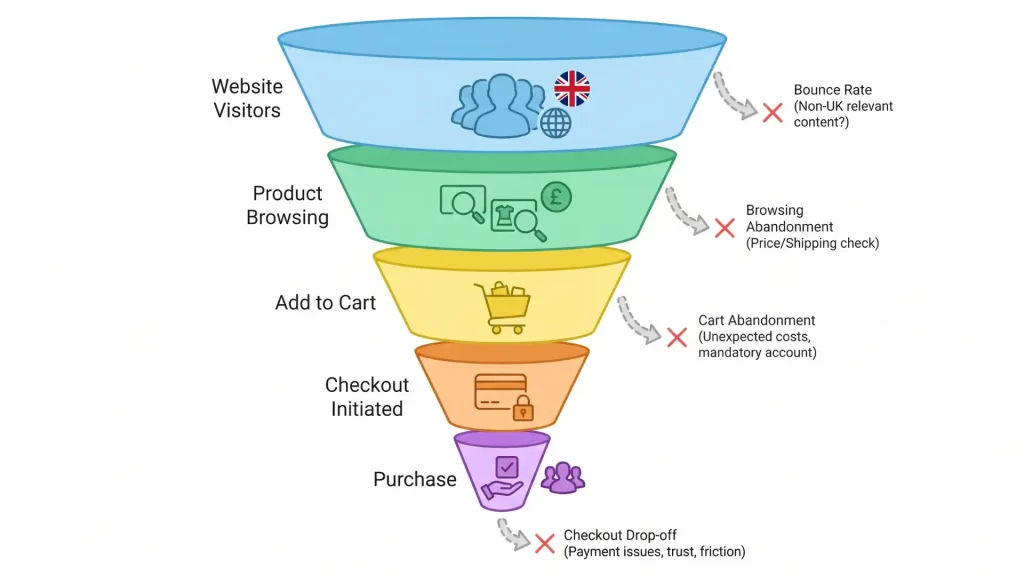
Hidden costs and checkout friction are killing your UK ecommerce sales
Checkout abandonment is the single most measurable conversion problem in ecommerce. Research from Baymard Institute consistently puts the average cart abandonment rate at around 70%, meaning seven out of every ten shoppers who add something to their cart still do not complete the purchase.
For UK retailers specifically, the most common causes are:
- Unexpected costs appearing at checkout — typically delivery fees or VAT that were not shown earlier in the journey. This is the number one abandonment driver across all ecommerce markets.
- Forced account creation before purchase. Many UK shoppers, particularly first-time buyers, will simply leave rather than sign up for yet another account.
- A checkout process with too many steps, too many form fields, or a layout that does not inspire confidence.
- A lack of trusted payment options — UK shoppers increasingly expect to see PayPal, Apple Pay, or Google Pay alongside standard card payments.
The fix here is methodical rather than dramatic. Show delivery costs early — ideally on the product page itself, or at the very latest in the basket. Enable guest checkout. Reduce the number of form fields to the absolute minimum. And make the checkout experience feel secure and professional throughout. Poor checkout flows also often stem from technical limitations in the platform itself, which is one of the reasons some growing retailers consider moving from template-based platforms to a purpose-built store — a decision explored in more detail in our article on the benefits of a custom built ecommerce site over Shopify.
You are not building enough trust at the right moments
Buying online requires a level of trust that many store owners underestimate. A visitor landing on your site for the first time has no prior relationship with you. They are considering handing over their payment details to a website they have never used before. If your store does not actively earn that trust — and at the right point in the journey — they will simply leave.
Trust signals include customer reviews, security badges, recognisable payment logos, clear return policies, and real product photography. Most UK stores have some of these, but the placement is often wrong. A return policy buried in the footer does nothing for someone hesitating on a product page. A single small padlock icon at the bottom of a checkout form does little to reassure someone who is already anxious about entering their card details.
The most effective approach is to place your strongest trust signal — whether that is a review count, a money-back guarantee, or a security badge — directly adjacent to your primary call to action. Move your returns policy onto the product page itself, not just the footer. If a product has fewer than ten reviews, prioritise generating reviews before spending more on driving traffic to that page.
Slow site speed is costing you UK ecommerce sales on mobile
Mobile is not an optional consideration for UK retailers — it is where the majority of your traffic is coming from. Most UK consumers browse and shop heavily on their phones, and if your store is not fast and easy to navigate on a small screen, they will leave before you have any chance to convert them.
Research consistently shows that a one-second delay in page load time can reduce conversions by around 7%. When load times stretch beyond three seconds, bounce rates increase sharply. Beyond that, Google uses site speed as a ranking signal — which means a slow store is not just losing sales it is generating, it is also losing organic traffic it could otherwise be attracting.
Quick wins for improving mobile speed
- Compress all images — this is the most common culprit in slow-loading ecommerce stores and often the quickest win
- Enable lazy loading so that images below the fold only load when the user scrolls to them
- Reduce the number of third-party scripts and apps loading on each page
- Use Google PageSpeed Insights to get a clear picture of where your site is losing performance points
If your store consistently takes more than three seconds to load on mobile, treat that as a priority issue rather than a background task. The revenue impact is direct and measurable.
You are attracting the wrong traffic
Sometimes the conversion problem is not on the site at all — it is in who is arriving. Traffic with no intent to buy will never convert, regardless of how good your product pages or checkout experience are.
This is worth checking carefully, especially if you are running paid ads. Are your campaigns targeting people who are genuinely in the market for what you sell, at the right stage of the buying journey? Broad keyword targeting, geographic mismatches (UK traffic from overseas sources, for example), and campaigns optimised for clicks rather than conversions can all generate impressive-looking traffic numbers that simply do not translate to revenue.
For organic traffic, the same principle applies. If your blog or landing pages are ranking for informational keywords — people researching rather than buying — you will see engagement without purchases. The fix is not to stop creating that content, but to make sure you also have conversion-focused pages targeting buyers who already know what they want.
You are making changes without testing them
One of the most common patterns in ecommerce is making changes based on instinct — updating a button colour, rewriting a headline, restructuring a product page — and then having no way to know whether the change helped, hurt, or made no difference at all. This is not just an inefficient way to improve your store. It is actively risky, because changes that feel like improvements can quietly reduce conversion rates without any obvious signal.
Conversion rate optimisation as a discipline is fundamentally about replacing opinions with evidence. Before changing anything significant on your store, write down what you expect to happen and why. Then measure the results. If your store generates enough traffic, proper A/B testing is the most reliable approach. For smaller stores, even simple before-and-after comparisons — run over consistent time periods and accounting for seasonal variation — are better than making changes with no tracking at all.
Using tools like Google Analytics 4 to identify which pages have high traffic but low conversion, and which steps in your checkout funnel see the most drop-off, gives you a prioritised list of where to focus rather than guessing.
Using chatbots and automation to recover lost sales
Not every visitor who leaves without buying is a lost cause. The question is whether your store has any mechanism for re-engaging them — or better still, addressing their hesitation before they leave.
Modern chatbots can do a great deal more than answer basic FAQs. They can guide undecided shoppers to the right product, answer questions about returns or delivery in real time, and surface the reassurance a customer needs at the exact moment they are considering abandoning their basket. For UK retailers with limited customer service resource, an AI chatbot running around the clock is a practical and cost-effective way to close the gap between interest and purchase.
Automated abandoned basket emails also remain one of the most reliable conversion recovery tools available, with email consistently outperforming the general ecommerce conversion average. Pairing these with a well-configured ecommerce chatbot that handles live enquiries gives your store two additional layers of conversion support that work passively, even outside business hours.
How to prioritise your ecommerce conversion rate optimisation efforts
Trying to fix everything at once is one of the most common mistakes in CRO. The result is usually a lot of activity and very little clarity about what actually moved the needle.
A more effective approach is to diagnose first. Use your analytics to identify the specific stage where your funnel is losing the most people. Then work on that problem before moving to the next.
As a rough guide:
- If your bounce rate is high and visitors are not exploring beyond the landing page, the issue is likely traffic quality, site speed, or a weak first impression
- If visitors browse but rarely add items to the basket, focus on product pages, trust signals, and pricing clarity
- If items are added to the basket but not purchased, checkout friction and unexpected costs are almost certainly the problem
- If your conversion rate seems reasonable but revenue is still below expectation, look at average order value — upselling, cross-selling, and bundle offers are often underused by UK retailers
The principle throughout is the same: focus on removing the specific friction your customers are actually experiencing, rather than making changes based on what you think might help.
Final thoughts: traffic is not the problem
The most important shift in thinking for any UK retailer dealing with low sales despite reasonable traffic is this: the issue is almost never that you need more visitors. It is that the visitors you already have are encountering friction, doubt, or a poor experience that stops them from buying.
Ecommerce conversion rate optimisation is not a one-off project. It is an ongoing process of understanding your customers, identifying where they are dropping off, and systematically removing the barriers between them and a purchase. Done consistently, it compounds — small improvements to multiple parts of the funnel add up to meaningful gains in revenue without any increase in your advertising spend.
For UK retailers looking to increase online sales by making more from existing traffic, that process starts with an honest look at how your store performs right now — and a willingness to let the data tell you where to focus first.
Is your ecommerce store getting traffic but no sales?
Getting traffic to your site is just the beginning, as the gap between clicks and conversions is where most online businesses quietly lose the game. If your store is leaking revenue, you might be losing customers to checkout friction, underperforming product pages, or a lack of trust signals.
Our team provides conversion-focused e-commerce website design, purpose-built custom ecommerce sites, and intelligent ecommerce chatbots to help UK retailers turn their existing visitors into paying customers.