
Benefits of a custom built ecommerce site over Shopify
Benefits of a custom built ecommerce site over Shopify
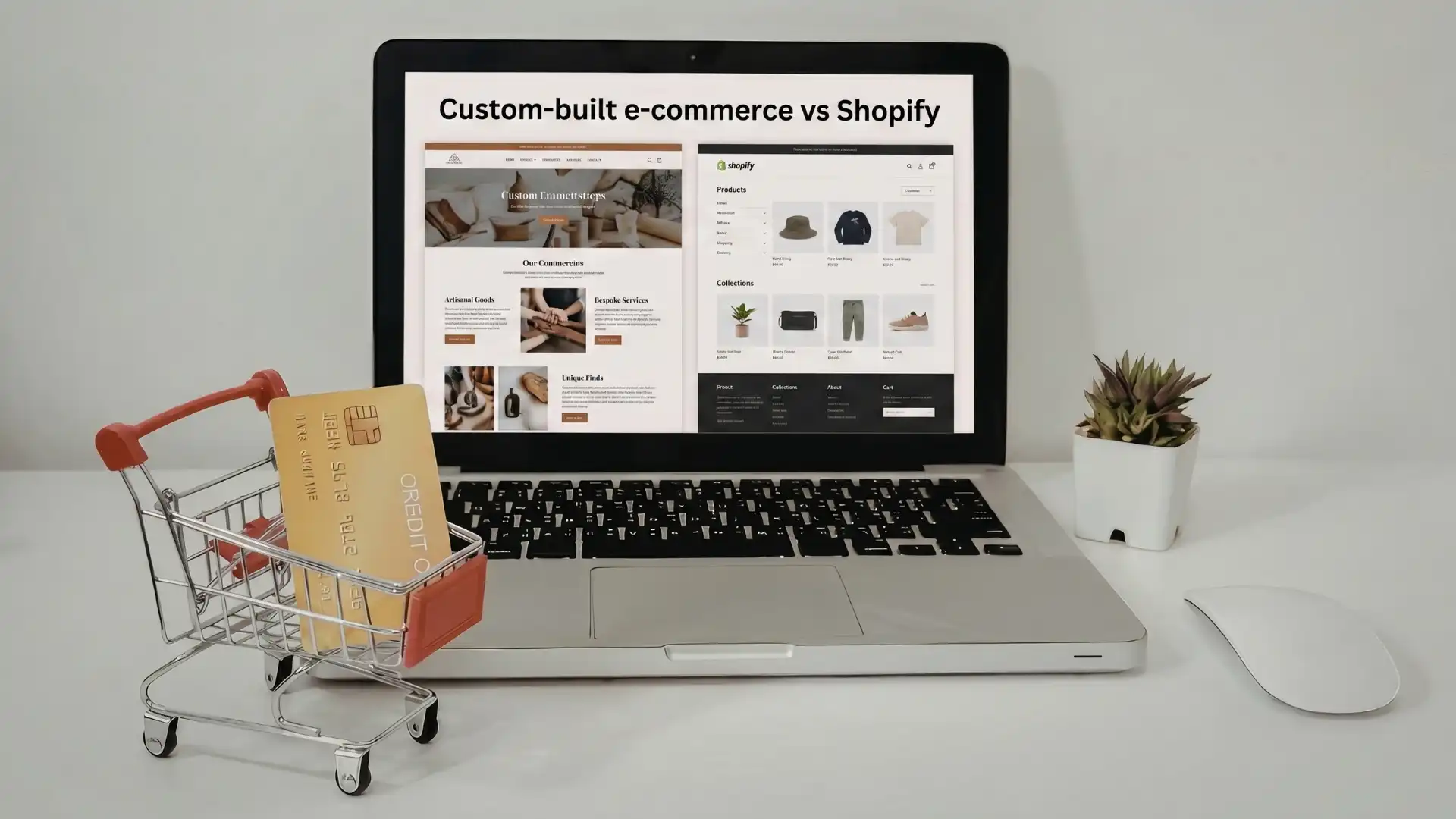
A custom built ecommerce site gives your business something that no template platform can offer: a system built entirely around the way you work. While Shopify is a capable option for businesses just starting out, it is a one-size-fits-all solution — and most growing businesses quickly discover its limits.
This article breaks down the real, practical advantages of going bespoke: from the way you manage orders and discounts to how your store connects with third-party tools, handles complex product logic, and scales without compromise.
Why a custom built ecommerce site gives you total control
With Shopify, you are working within a framework that was designed to suit the broadest possible audience. That is useful for launching quickly, but it means accepting constraints that were never designed with your specific business in mind.
A custom built ecommerce site, by contrast, is engineered from the ground up to reflect how your business operates. Every page, every workflow, and every customer-facing feature is shaped around your requirements — not around what the platform allows.
This distinction matters more than it might appear. As your business grows, the limitations of a templated platform become increasingly frustrating. Custom builds grow with you; Shopify grows in the direction Shopify chooses.
For a related practical reference on planning short-form video production, see CapCut video editor features.
Flexible order management built around your process
One of the most significant practical advantages of a bespoke ecommerce website is how orders can be managed. Shopify gives you a fixed order management interface. You can fulfil, refund, and archive — but everything follows Shopify’s predefined logic.
A custom built system lets you define the entire order lifecycle. That might mean:
- Custom order statuses that match your internal fulfilment stages (for example: pending approval, awaiting supplier, partially dispatched, awaiting collection)
- Multi-warehouse or multi-location stock allocation, with rules for which warehouse fulfils which order automatically
- B2B and trade account order flows, where orders require approval before processing or can be placed against a credit account
- Partial shipment and split-order handling, which is particularly important for businesses selling products that ship from different locations or at different times
- Custom packing slips, despatch notes, and invoice templates that match your brand and operational needs exactly
None of these are straightforward to achieve on Shopify without layers of third-party apps — each of which adds cost, introduces compatibility risks, and still only approximates what a bespoke ecommerce website delivers natively.
More powerful and flexible discount systems
Shopify’s discount engine is reasonably capable at the basic level — percentage off, fixed amount, buy X get Y. But businesses with more complex promotional needs run into its limits quickly.
A custom built ecommerce site can implement discount logic of any complexity:
- Tiered pricing for trade customers, where the price automatically adjusts based on the account type or the volume being ordered
- Quantity-based discounts that vary by product category, with different rules for different customer segments
- Bundle discounts that apply when specific combinations of products are purchased together, even across different departments or suppliers
- Time-limited promotional pricing with automatic start and end times, without needing to manually turn promotions on and off
- Loyalty-linked discounts tied to customer spend history or account age, without needing a separate loyalty app
This level of promotional control is particularly valuable for businesses in competitive retail markets, wholesale, or subscription-based models where standard discount logic simply does not reflect how sales are structured.
Deep integrations with third-party software and internal systems
Most businesses do not operate in isolation. They use accounting software, warehouse management systems, CRM platforms, supplier portals, logistics APIs, and marketing automation tools. Connecting all of these to a Shopify store involves working through whatever integrations Shopify’s app ecosystem happens to support — and accepting the limitations of those connections.
With a custom built ecommerce site, integrations are built specifically for your systems. That means:
- Direct API connections to your accounting software — whether that’s Xero, Sage, QuickBooks, or a bespoke accounts system — so orders, invoices, and payments sync automatically without manual exports
- Real-time stock feeds from supplier or warehouse systems, so your site always reflects live inventory without scheduled updates or manual adjustments
- CRM integration that passes customer order history, preferences, and behaviour directly into your sales team’s platform
- Logistics and courier API connections that generate shipping labels, trigger tracking emails, and update order statuses automatically
- ERP integrations for businesses with more complex operational infrastructure, connecting the ecommerce layer directly into core business processes
This kind of connected infrastructure is what separates businesses that operate efficiently from those that spend hours manually reconciling data between systems. The bespoke ecommerce development work we do is frequently built around exactly this challenge — connecting a custom store to the systems a business already relies on.
Custom coding that makes your product catalogue work harder
Product catalogues vary enormously between businesses. Some have simple one-size products. Others manage thousands of SKUs with complex variants, configurable options, custom pricing matrices, or product dependencies.
Shopify handles straightforward catalogues well. But once you introduce configurable products, products with interdependent options, products that are built-to-order, or products priced dynamically based on specifications, you are quickly into territory where Shopify’s product model no longer fits.
A bespoke ecommerce website can implement custom product logic at the code level. A configurator that builds a final product price based on selected dimensions, materials, and finishes. A subscription model with custom billing cycles, pause options, and mid-cycle changes. A product recommendation engine that genuinely reflects your catalogue relationships rather than generic cross-sell rules.
These are not cosmetic improvements — they directly affect conversion rates, average order value, and customer satisfaction.
No transaction fees and complete payment flexibility
Shopify charges transaction fees on every sale unless you use Shopify Payments. For high-volume businesses, these fees represent a significant ongoing cost — one that grows directly in proportion to your success.
A custom built ecommerce site connects directly to any payment gateway you choose — Stripe, Worldpay, PayPal, SagePay, or any specialist provider that suits your market. There is no intermediary platform taking a percentage. Choosing the right payment processor for your business model is a decision worth making carefully, and understanding the differences between payment processors can have a real impact on your bottom line.
Beyond fees, payment flexibility matters for international businesses, high-risk categories, B2B invoice payments, and businesses that want to offer buy-now-pay-later, direct debit, or account-based payment terms — all of which can be natively supported in a custom build without routing through third-party apps.
Superior SEO capabilities and performance optimisation
Shopify provides a reasonable starting point for SEO, but it constrains you in several technical areas: URL structure is largely fixed, page speed depends heavily on the theme, and schema markup is limited to what the platform provides natively.
A custom built ecommerce site allows complete technical SEO control. URL architecture, internal linking logic, canonical tags, structured data, server-side rendering, lazy loading strategies, and core web vitals optimisation can all be implemented at the code level.
Performance is particularly important in ecommerce, where page speed directly affects both conversion rate and search engine ranking. A lightweight, purpose-built codebase consistently outperforms a theme-based Shopify store loaded with app scripts — particularly on mobile, where the majority of ecommerce traffic now originates.
Long-term value and freedom from platform dependency
Shopify’s monthly subscription, app fees, theme costs, and transaction fees add up to a meaningful ongoing expenditure. More importantly, every pound you spend goes to maintaining a platform you do not own and cannot fully control.
A custom built ecommerce site is yours. You own the code. You choose your hosting. You decide when to update, what to add, and how the system evolves. There is no risk of the platform changing its pricing model, deprecating features you rely on, or limiting your ability to scale.
For businesses with growing revenue and increasing operational complexity, the investment in bespoke ecommerce development typically pays back significantly over a three-to-five year horizon — through reduced ongoing costs, avoided workarounds, and the compounding value of a system that genuinely fits the business.
Common questions about custom built ecommerce sites
Is a custom built ecommerce site only for large businesses?
Not at all. While the initial investment is higher than a Shopify subscription, custom builds are well suited to any business that has specific requirements, complex products, or operational processes that a standard platform cannot accommodate. Many mid-sized businesses find the investment justified within the first year.
How long does a bespoke ecommerce website take to build?
Timescales vary by complexity, but a well-scoped ecommerce development project typically takes eight to sixteen weeks from brief to launch. More complex builds involving multiple integrations, large catalogues, or custom product logic will take longer. Good planning at the start of a project significantly reduces development time.
Can a custom site be updated without a developer?
Yes. A well-built bespoke ecommerce website includes a fully featured admin system that allows you to manage products, orders, customers, promotions, and content without touching code. Developer involvement is only needed when adding new features or making structural changes.
What about security and hosting?
Security is managed by your development team or hosting provider, giving you complete control over your environment. Hosting can be chosen to match your performance requirements, geographical needs, and budget — rather than being locked to a single platform’s infrastructure.
The right platform for businesses that have outgrown templates
Shopify is a genuinely useful platform for businesses that are starting out or that have straightforward ecommerce needs. But for businesses that need full control over their order management, flexible discount structures, deep third-party integrations, and a distinctive brand experience, a custom built ecommerce site is the only platform that truly delivers.
The businesses that invest in bespoke ecommerce development are not just buying a website — they are building a commercial system that supports every part of how they sell, fulfil, and grow. That is an investment that compounds over time in ways that no subscription platform can match.
Not sure whether Shopify is limiting your ecommerce growth?
Many businesses start on Shopify because it’s quick to launch — but as requirements become more complex, platform limits begin to affect operations, integrations, and long-term costs. A custom built ecommerce site gives you full control over your order workflows, discount logic, integrations, and customer experience. We help businesses plan and deliver bespoke ecommerce platforms designed to scale properly as they grow.