
Shopify vs WooCommerce vs custom build: which ecommerce platform is right for your UK business in 2026?
Shopify vs WooCommerce vs custom build: which ecommerce platform is right for your UK business in 2026?
Picking the right ecommerce platform UK businesses can rely on is one of the most consequential digital decisions you will make. Get it right and you have a store that grows with you. Get it wrong and you are either trapped in a system that does not fit, or paying thousands to migrate later.
The three platforms that come up most often in 2026 are Shopify, WooCommerce, and a fully custom ecommerce website. Each one has genuine strengths — and genuine limitations. This guide breaks down what each option actually means in practice, who each one suits, and how to make the decision without second-guessing yourself later.
Why the ecommerce platform UK businesses choose really matters
Your ecommerce platform is not just where your products live. It shapes how your checkout works, how you manage orders, how well your store ranks on Google, and how easily you can scale when demand increases. It also determines your ongoing costs for the next three to five years.
Many businesses choose a platform based on what they have heard from others or what looks quickest to launch. That approach can work — but it can also lead to expensive rework when your real requirements emerge. Understanding the differences upfront saves you a lot of trouble down the line.
Shopify: the fast-launch ecommerce platform for UK retailers
Shopify is a fully hosted platform, which means it handles your infrastructure — security, updates, uptime, payment processing — so you do not have to. You pay a monthly subscription and focus on your products and customers.
For many UK businesses, especially those launching for the first time or those with a straightforward product catalogue, this is a compelling offer. A Shopify store can be live in two to six weeks. The dashboard is clean and intuitive, and most team members can get to grips with it quickly.
Where Shopify excels
- Speed to market — up and running in a matter of weeks, not months
- Managed reliability — Shopify handles uptime, security patches and PCI compliance
- App ecosystem — over 8,000 apps covering subscriptions, loyalty, email marketing, shipping and more
- Shopify Payments integration — seamless checkout for UK customers with no extra transaction fee
Where Shopify falls short
The costs compound. The headline subscription (from around £65 per month on the core plan) is only the starting point. Most established Shopify stores run four to six paid apps on top — email marketing, reviews, advanced reporting, returns management. Realistically, that puts ongoing platform costs at £150 to £350 per month, or more.
Shopify also charges an additional transaction fee of 0.5% to 2% if you use a payment processor other than Shopify Payments. For UK businesses with existing relationships with Opayo, Worldpay or Barclaycard, this cost is unavoidable and adds up quickly at volume.
SEO is also worth considering. Shopify enforces certain URL structures and has some limitations around canonical tags and URL redirects that experienced SEOs find frustrating. It is manageable, but it does require more effort than WooCommerce to compete for competitive organic search terms.
Shopify is also a walled garden. You do not fully own your store data or your codebase. If Shopify changes its pricing or terms, your options are limited.
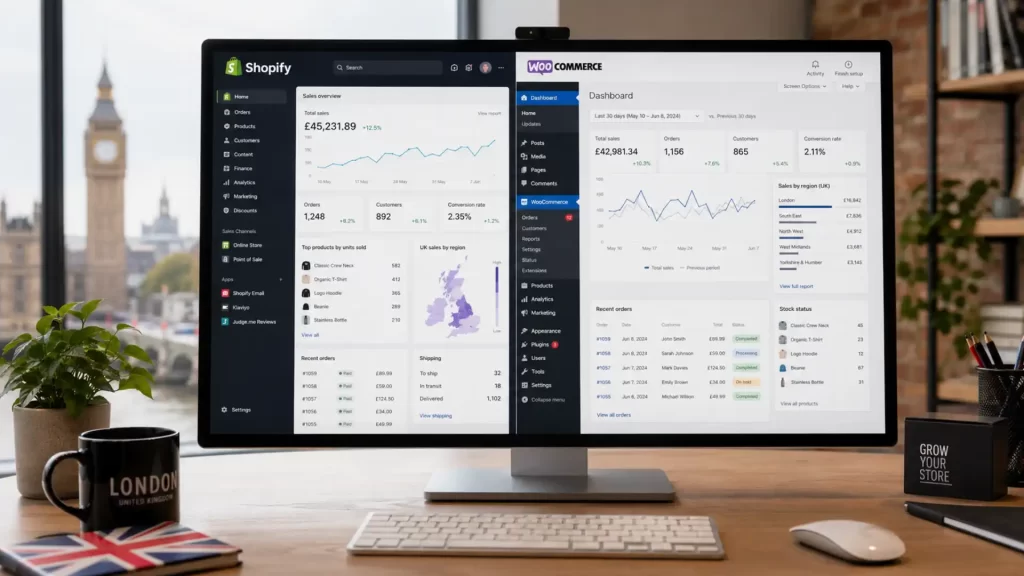
WooCommerce: the flexible ecommerce platform UK businesses can truly own
WooCommerce is an open-source plugin for WordPress. It is free to install, and you pay for hosting, premium extensions, and the development work needed to build your store. On a Shopify vs WooCommerce comparison, this is the key structural difference: WooCommerce is yours. Your data sits on your server, your codebase belongs to you, and there is no third-party platform that can change the rules on you.
It is the most widely deployed ecommerce platform in the world by site count — a fact that often surprises people who assume Shopify dominates across all metrics. The ecosystem is enormous, and the pool of developers who understand the platform is large, which keeps costs competitive.
Where WooCommerce excels
- No transaction fees from the platform itself — you only pay your payment gateway
- Full SEO control — URL structure, meta tags, schema, content architecture are all in your hands
- Complex product types handled well — variable products, bundles, subscriptions, trade pricing
- Content and commerce in one system — ideal for brands where editorial content and shopping are tightly linked
- Lower long-term platform costs — over a five-year period, WooCommerce is frequently the cheaper option for growing stores
Where WooCommerce falls short
WooCommerce is not managed in the way Shopify is. You are responsible for choosing the right hosting, keeping plugins updated, and monitoring site security. A WooCommerce store that is not properly maintained can become slow, vulnerable, or both. This means either having technical resource in-house or working with a digital agency that offers ongoing site management.
Setup also takes longer and costs slightly more upfront than a Shopify equivalent. That investment is typically recovered through lower monthly running costs within 18 to 24 months for a store of meaningful size.
If you are building a WooCommerce store and want a properly structured setup that will hold up as your business scales, our WooCommerce website design service covers platform configuration, theme development, and extension setup from the ground up.
Not sure which ecommerce platform UK businesses in your position are choosing?
It depends heavily on your product type, growth plans, and budget — and there is rarely one universally correct answer. Our team works with both Shopify and WooCommerce builds regularly, and we will give you an honest recommendation based on your situation, not what is easiest for us to build. Talk to our team for a free, no-obligation conversation and we will help you work it out.
Custom ecommerce website: when bespoke is the right answer
A custom ecommerce website — built from scratch on a modern framework such as Next.js with a headless commerce backend — is the right choice in a narrower set of circumstances than many businesses assume. It is not a prestige option or a way of spending more money for the sake of it. It is the correct technical answer when your requirements genuinely cannot be met by an off-the-shelf platform.
Custom builds are typically justified when:
- Your business model requires functionality that no plugin can replicate — custom subscription logic, dynamic pricing algorithms, marketplace functionality between multiple sellers, or deep integration with bespoke ERP or warehouse management systems
- You are building an ecommerce platform as a product itself, such as a white-label solution or a vertical-market tool for your industry
- Your brand experience requires interactions that are simply impossible within Shopify or WooCommerce — complex product configurators, AR visualisation, or heavily animated purchase journeys
- You are operating at very high transaction volumes where every millisecond of load time has a measurable impact on conversion
For most UK businesses turning over under £5 million annually with a reasonably standard product catalogue, a custom ecommerce website is likely overkill. The build cost starts at £20,000 and scales significantly with complexity. Shopify or WooCommerce will serve the same business better — faster, cheaper, and with a far larger ecosystem of off-the-shelf tools.
That said, if your requirements are genuinely complex, a custom build pays for itself in avoided compromises and long-term operational efficiency. Our broader e-commerce website design services include everything from managed Shopify and WooCommerce builds through to fully bespoke online stores.
Shopify vs WooCommerce vs custom build: at a glance
Here is how the three options compare across the factors that matter most for UK businesses:
| Factor | Shopify | WooCommerce | Custom build |
|---|---|---|---|
| Setup speed | Fast (2–6 weeks) | Moderate (4–8 weeks) | Slow (3–6 months) |
| Monthly costs | £65–£344+ platform fees + apps | Hosting only (£30–£100/mo) | Hosting + dev retainer |
| Transaction fees | Yes (if not using Shopify Pay) | None from platform | None from platform |
| Design flexibility | High within Shopify framework | Very high — open source | Unlimited |
| SEO control | Good (some limitations) | Excellent — full control | Excellent — full control |
| Technical burden | Low — Shopify manages it | Medium — you manage hosting | High — fully bespoke |
| Data ownership | Partial (Shopify holds data) | Full — your server | Full — your codebase |
| Best for | Fast-launch retail stores | Complex products, B2B, content | Unique business logic, scale |
How to choose the right ecommerce platform UK businesses should consider
Rather than starting with the platforms and working backwards, start with your business requirements. These five questions will point you in the right direction:
1. How many products do you have, and how complex are they?
Under 200 products with simple variations — Shopify is likely sufficient. A few hundred products with bundled options, subscription variations or trade-pricing tiers — WooCommerce gives you more control without the cost of a custom build. Thousands of SKUs with bespoke pricing logic and ERP integration — a custom ecommerce website is worth considering.
2. How important is SEO to your growth strategy?
If organic search will be a significant revenue driver, WooCommerce gives you more control over the technical foundations that determine rankings. Shopify can rank well, but it requires more workarounds and accepts some structural limitations you simply do not have with WooCommerce.
3. What does your technical resource look like?
If nobody in your team has technical knowledge and you do not want a developer relationship, Shopify is the lowest-friction option. If you have a developer available — or you are working with an agency that offers ongoing support — WooCommerce is worth the added flexibility.
4. What is your five-year total cost of ownership?
Shopify costs compound over time. A store spending £200 per month in subscriptions and apps spends £12,000 over five years on platform costs alone, regardless of revenue. WooCommerce costs are front-loaded in development and hosting, with lower ongoing fees. For stores with meaningful turnover, WooCommerce is often cheaper over a five-year horizon even after accounting for the higher upfront build cost.
5. Do you need specific UK payment or shipping integrations?
Both Shopify and WooCommerce support the major UK payment providers and carriers. The key difference is fees: Shopify charges 0.5% to 2% per transaction if you use an external processor. WooCommerce charges nothing. For businesses with an existing relationship with Opayo, Barclaycard or GoCardless, WooCommerce avoids an ongoing cost that adds up at volume.
UK businesses can also refer to Ofcom’s guidance on digital trading standards and consumer rights when planning their online store setup — it is worth understanding the regulatory context your platform choice sits within.
What about Shopify website design specifically?
If you have already decided Shopify is the right fit, the quality of the design and build matters enormously. An out-of-the-box Shopify theme applied with minimal customisation may launch quickly, but it is unlikely to reflect your brand properly or convert at the level a purposefully designed store can achieve.
Our Shopify website design service is built around conversion-focused design, structured product pages, smooth checkout flows, and integrations with the systems your business already uses — rather than adapting a template that was never built with your customers in mind.
Ready to choose the right ecommerce platform for your UK business?
Whether you are starting fresh or rethinking a platform that is no longer working for you, the decision is too important to rush. Our team builds and launches Shopify stores, WooCommerce stores, and custom ecommerce websites for UK businesses — and we will help you choose the right option before a single line of code is written.
There is no one-size-fits-all answer in the Shopify vs WooCommerce debate, but there is a right answer for your business specifically. Let’s find it together.