
How long does it take to develop a mobile app? (Real timelines)
How long does it take to develop a mobile app? (Real timelines)
It’s usually the second question a business asks about a mobile app, right after cost. And it’s a fair one — a launch date affects budgets, marketing plans, and sometimes a funding round. The honest answer is that most business apps take somewhere between three and nine months from a standing start to a public launch, but that range hides a lot of detail worth understanding before you commit to a date.
This guide breaks down realistic mobile app development timelines by complexity, walks through what happens at each stage, and — just as importantly — covers what tends to push projects past their original estimate in practice.
If you’re researching how long does it take to develop a mobile app, the sections below give you a realistic picture of the stages, timescales and factors that affect the final launch date.
How long does it take to develop a mobile app? The honest answer: most apps take 3 to 9 months
A simple, single-purpose app can be built in a matter of weeks. A fully custom platform with logins, payments, real-time data and multiple integrations can take a year or more. Most business apps sit somewhere in the middle, and the timeline is driven far more by scope and decision-making speed than by the actual typing of code.
Independent industry benchmarks put the typical mobile app development timeline at around 20 to 40 weeks, or roughly 5 to 9 months, once planning, design, build and testing are all accounted for. That figure assumes a reasonably scoped, single-platform or cross-platform project with an engaged client and no major changes of direction partway through.
How long does it take to develop a mobile app by complexity?
Complexity is the single biggest factor in how long an app takes to build. As a general guide:
| App type | Typical timeline | Examples |
|---|---|---|
| Simple app | Several weeks to 3 months | Booking form, single-workflow tool, basic internal utility |
| Medium complexity | 3 to 7 months | Customer-facing app with logins, a booking or ordering flow, CRM integration |
| Complex / enterprise app | 7 to 12+ months | Multi-role platforms, real-time data, payments, heavy third-party integrations |
These are useful starting points, not guarantees. An app with a short feature list but a genuinely novel integration — syncing live data with an unusual legacy system, for example — can easily take longer than a feature-rich app built on familiar, well-documented tools.
How long does it take to develop a mobile app? The stages that make up the timeline
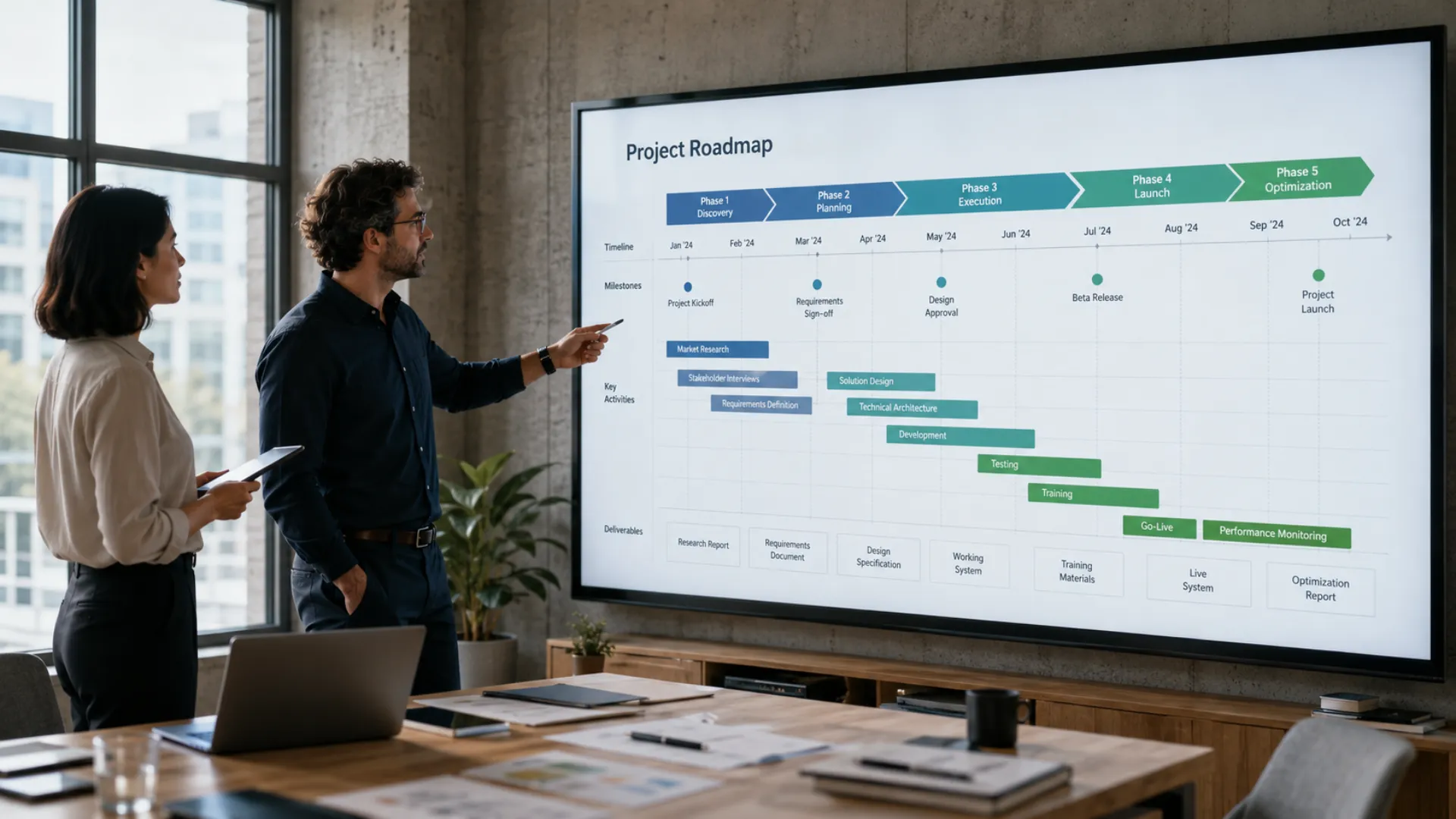
Regardless of complexity, most mobile app projects move through the same broad stages. Understanding what happens in each one makes it much easier to judge whether a quoted timeline is realistic.
Discovery and planning (1 to 3 weeks)
This is where requirements, target users, must-have features and platform choice (iOS, Android, or both) get defined. Skipping or rushing this stage is one of the most common causes of delay later on, because unclear requirements tend to resurface as changes mid-build.
Design: UI and UX (2 to 4 weeks)
Wireframes, user flows and visual design happen here, usually across a few rounds of feedback. A simple app with a handful of screens moves through this quickly; an app with several user roles or complex navigation needs more iteration.
Development: the build itself (1 to 6 months)
This is typically the longest stage, and it’s where frontend, backend, and any third-party integrations — payment providers, CRM systems, authentication, analytics — actually get built and connected. It’s also the stage most exposed to scope changes, since new requirements surface once stakeholders can see working screens rather than mockups.
Testing and QA (2 to 6 weeks)
Functional testing, device and OS compatibility checks, performance testing and bug fixes happen in parallel with, and after, development. Apps handling payments, user data or multiple user roles need more thorough testing, which extends this stage.
App store submission and launch (1 to 2 weeks, plus review time)
Once the build is ready, it’s submitted to the Apple App Store and/or Google Play. Apple typically reviews most submissions within a day or two, though new developer accounts and more complex apps can take longer. Google Play is often faster for routine updates but can take several days for a first submission from a new account. Building in a buffer here, rather than promising a launch date to the day, avoids unnecessary pressure if a resubmission is needed.
Post-launch (2 to 4 weeks, and ongoing)
A launch date isn’t really the finish line. Monitoring crash reports, tracking early user feedback, and shipping quick fixes in the first few weeks is standard practice — and worth planning for rather than treating as an afterthought.

What actually slows projects down
Official timelines assume a clean run. In practice, a handful of recurring issues are responsible for most projects that overrun their original estimate.
- Changing requirements mid-build — every new feature or altered workflow requested after development has started tends to ripple backwards into design and testing, not just forwards.
- Underestimating integrations — connecting to a CRM, payment provider or legacy system is rarely a simple task, and it’s a common source of delay when it’s treated as an afterthought rather than scoped early.
- Inexperienced or under-resourced teams — a small, experienced team can often out-pace a larger but less coordinated one, particularly on business apps where clean architecture matters more than headcount.
- Slow client-side decisions — feedback and approval cycles that stretch from days into weeks add up quickly across a multi-month project.
- Treating testing as an afterthought — squeezing QA into the final days before launch is one of the most common causes of a last-minute delay.
None of these are unusual or a sign that a project has gone wrong. They’re simply the reason a well-planned app development timeline includes some contingency, rather than assuming everything will go exactly to the original schedule.
When working out how long does it take to develop a mobile app, this contingency needs to be considered alongside the development work itself.
Native vs cross-platform: how framework choice affects your timeline
The technology you build with has a direct effect on how long development takes. Building separate native apps for iOS and Android — effectively two parallel codebases — takes longer and costs more than a cross-platform approach that shares one codebase across both.
Framework choice is therefore important when determining how long does it take to develop a mobile app, particularly when the finished product needs to support both iOS and Android.
Frameworks like Ionic, Flutter and React Native exist precisely to close that gap, letting a single development effort reach both platforms (and often a browser-based version too). For a closer look at how one of the most established cross-platform frameworks holds up, our guide to Ionic app development in 2026 covers where it speeds things up and where a native build still makes more sense.
Ready to scope a realistic timeline for your app?
The clearest way to get an accurate mobile app development timeline is to talk through your specific requirements with a team that can scope the build properly, rather than working from a generic estimate.
How to keep your mobile app timeline realistic
If you are trying to establish how long does it take to develop a mobile app for your business, controlling scope and decision-making is one of the most effective ways to keep the timeline realistic.
- Start with an MVP — build the core workflow first, and treat nice-to-have features as a phase two rather than a launch requirement.
- Lock your scope before development starts — requirements can evolve during planning, but changes get expensive and slow once the build is underway.
- Scope integrations early — if the app needs to talk to a CRM, booking system or payment provider, get that mapped out in discovery, not halfway through the build.
- Build in app store review time — don’t promise a launch date without a buffer for review and potential resubmission.
- Choose the right framework for the job — a cross-platform approach can meaningfully shorten the timeline for most business apps, without meaningfully compromising the result.

So, how long does it take to develop a mobile app?
For most UK businesses building a customer-facing or internal mobile app, a realistic planning range is 3 to 7 months from a clearly scoped brief to launch. Simpler, single-workflow apps can move faster; apps with heavy integrations, multiple user roles or regulatory requirements should plan for longer. The single biggest lever you have over your own timeline isn’t the framework or the developer’s typing speed — it’s how clearly the scope is defined before development begins.
If you’re planning a mobile app and want a straight answer on what your specific project would actually take, our mobile app development team can walk you through a realistic scope and timeline before you commit to anything.
Frequently asked questions
How long does it take to develop a mobile app if the app is simple?
A simple, single-purpose app — a basic booking form or an internal utility with a handful of screens — can typically be built in several weeks to three months, depending on how much backend and integration work is involved.
Can a mobile app be built faster than the typical timeline?
Yes, within reason. Starting with a tightly scoped MVP, choosing a cross-platform framework, and keeping requirements fixed once development starts are the most effective ways to compress a timeline without cutting corners on quality.
Does app store approval add much time to the launch?
Usually not much if you plan for it. Apple typically reviews most submissions within a day or two, and Google Play often reviews new apps within a few hours to a few days. First submissions and more complex apps can take longer, so it’s sensible to build in a short buffer rather than announcing a launch date before the app has cleared review.
Why do app projects often take longer than the original estimate?
The most common causes are changing requirements after development has started, integrations that turn out to be more complex than expected, and testing being left too late in the schedule. A clear, locked scope at the start of the project is the single best protection against timeline slippage.
Timelines in this guide are general planning ranges based on typical UK business app projects. Every project is different, and the only way to get an accurate timeline for your specific app is a proper scoping conversation.
Ready to explore app development for your Manchester business?
Webphoria builds mobile apps for growing businesses across Greater Manchester and beyond.
Whether you are starting with a clear brief or still working out whether an app is the right move, we can give you a straight answer and a clear picture of what is involved.
For businesses looking at app development Manchester services, we build for iOS, Android, and cross-platform using the approach that fits your project — not the one that is easiest for us.
Get in touch and tell us about your idea.