
App development Manchester: how to build an app for your business

App development Manchester: how to build an app for your business
More Manchester businesses are building apps than ever before — not just the large consumer brands, but SMEs, professional services firms, logistics companies, hospitality businesses, and startups that need to put specific tools in the hands of their customers, their staff, or both.
For anyone researching app development Manchester services, the practical questions are usually where to start, what it will cost, and how to avoid the mistakes that turn a sensible investment into an expensive problem.
This guide walks you through everything a business owner in Greater Manchester needs to understand before commissioning mobile app development: what type of app suits your needs, how the development process works, what it realistically costs, and how to find the right development partner. It is designed to help you ask the right questions and make the right decisions — not to sell you on any particular approach.
App development Manchester: does your business actually need a mobile app?
This is the most important question to answer before anything else — and the honest answer is that not every business needs a mobile app.
A well-built, mobile-responsive website handles the majority of what most business websites need to do, and building an app that duplicates a website’s functionality without adding meaningful capability is an expensive way to solve a problem that does not exist.
An app makes sense when it delivers something a website cannot do as well. That usually means one or more of the following:
- Your users need offline access to data or functionality — field engineers, delivery drivers, or staff working in areas with poor connectivity
- Your app needs to use native device features intensively — the camera, GPS, push notifications, biometrics, or Bluetooth — in ways that a mobile website handles poorly
- You need to give customers or staff a fast, focused tool that they will use repeatedly, and a dedicated app icon on their device is a meaningful part of that experience
- You are running a service that requires a persistent relationship with the device — tracking, background data sync, or ongoing notifications
- Your current process relies on manual or paper-based workflows that could be digitised and streamlined by putting a tool in the hands of the people doing the work
If your primary need is a professional mobile-optimised presence for your business, a well-built mobile website is likely the more cost-effective first step.
Apps and websites serve different purposes, and understanding which one serves your purpose is the right place to start.
Types of mobile app: native, hybrid, and web apps
The first technical decision in any app development Manchester project is the type of app you are building. The options have different costs, performance characteristics, and development timelines, and the right choice depends on your requirements.
Native apps
Native apps are built specifically for a single platform — iOS using Swift or Objective-C, Android using Kotlin or Java.
They offer the best performance, the deepest integration with device hardware, and the most polished user experience on each platform.
The trade-off is that building native means building twice — a separate app for each operating system, with separate codebases, separate development teams, and separate ongoing maintenance.
For apps where peak performance is essential — real-time processing, complex graphics, intensive hardware use — native is the right choice. For most business apps, the cost premium is hard to justify.
Cross-platform and hybrid apps
Cross-platform frameworks — most commonly React Native and Flutter — allow developers to write a single codebase that compiles to both iOS and Android.
This significantly reduces development cost and ongoing maintenance overhead while delivering performance and a user experience that, for most business applications, is indistinguishable from native.
The Ionic framework, covered in more detail in our guide to Ionic app development, is another widely used cross-platform approach that leverages web technologies for the core build while accessing native device features through a structured plugin system.
For the vast majority of app development Manchester business projects, a cross-platform approach delivers the best balance of capability, cost, and speed to market.
Progressive web apps (PWAs)
A progressive web app is a website that behaves like an app — it can be installed on a device’s home screen, works offline, sends push notifications, and loads quickly.
PWAs do not appear in the App Store or Google Play, which limits their discoverability, and they cannot access all native device features.
For some business use cases, however — particularly where the audience is known and the priority is low-friction access to specific functionality — a PWA can deliver much of the value of a native app at significantly lower cost.
App development Manchester: how a business app project works
Understanding the development process helps you engage meaningfully with an agency, set realistic expectations, and avoid the most common causes of delays and cost overruns.
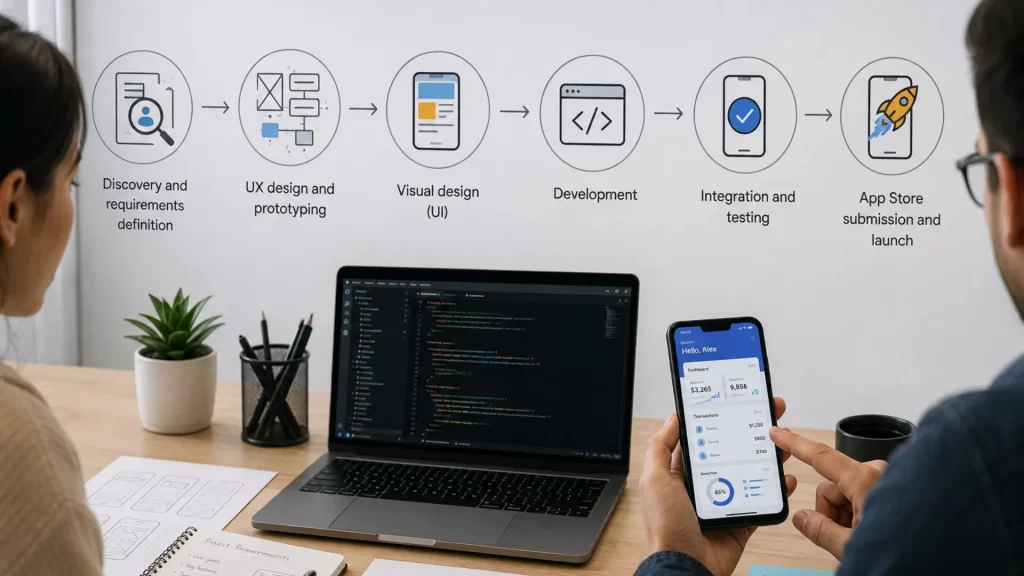
A well-run app development Manchester project moves through several distinct phases.
Discovery and requirements definition
The most important phase is also the one most often skimped on.
Discovery involves properly defining what the app needs to do, who will use it, how they will use it, and what success looks like. This means mapping user journeys, documenting functional requirements, identifying integrations with existing systems, and establishing the technical constraints of the project.
Agencies that skip this phase and move straight to design are setting the project up to drift.
For a business app project, discovery also involves understanding the back-end systems the app needs to connect to — whether that is an existing CRM, an ERP, a custom database, or a third-party API.
The complexity of these integrations is one of the largest drivers of development cost and is best understood at the start rather than discovered mid-build.
UX design and prototyping
Once requirements are defined, the user experience (UX) design phase maps the flows a user will move through — how they navigate between screens, what happens when they complete an action, how errors are handled.
This phase produces wireframes and interactive prototypes that can be tested with real users before any code is written.
Testing at the prototype stage is far cheaper than changing a built product, and it consistently produces better outcomes.
Visual design (UI)
User interface design applies your brand identity to the UX wireframes, producing the visual design of every screen in the app.
For business apps used by your own team, the priority is clarity and speed of use. For customer-facing apps, the visual quality of the design directly affects how the app is perceived and whether users return to it.
Development
The build phase translates the approved designs into a functioning app.
For most projects this is done in sprints — short development cycles, typically two weeks, that produce working functionality for review and feedback.
Regular sprint reviews keep the project on track and give you the opportunity to refine requirements as you see the product taking shape. Changes are much cheaper to make during development sprints than after a full build is complete.
Integration and testing
Any connections to external systems — APIs, databases, authentication services, payment providers — are built and tested during this phase.
Thorough testing covers functionality (does it work?), performance (does it work under load?), security (are there vulnerabilities?), and compatibility across the range of devices and OS versions your users will have.
Skimping on testing is one of the most common causes of app failures after launch.
App Store submission and launch
Publishing an app to the Apple App Store or Google Play requires approval from each platform.
Apple’s review process is typically the more demanding of the two and can take several days. Both platforms have specific technical requirements for apps submitted for review.
Working with an experienced agency means these requirements are considered from the start rather than discovered through a failed submission.
App development Manchester costs: what should you budget?
App development costs are highly variable, and any agency that gives you a precise price without understanding your requirements in detail is either making significant assumptions or proposing a scope much narrower than you probably need.
For businesses comparing app development Manchester providers, the following ranges are a realistic guide for business app projects in 2026.
Simple business apps: £15,000 to £35,000
A straightforward business app — a tool for a field team, a basic customer-facing booking or ordering app, an internal reporting dashboard — typically falls in this range when built using a cross-platform framework.
This assumes a limited number of screens, straightforward data requirements, and standard integrations.
It covers discovery, UX design, visual design, build, testing, and submission.
Mid-complexity apps: £35,000 to £80,000
Apps with more sophisticated functionality — complex user flows, multiple user roles, real-time data, significant system integrations, or custom backend development — typically fall in the mid-range.
Most growing business apps that genuinely replace a manual or paper-based process, or create a meaningful new customer channel, sit here.
Complex or enterprise apps: £80,000 and above
Large-scale apps with advanced functionality, AI integration, complex data processing, enterprise system integrations, or significant security and compliance requirements can cost considerably more.
The cost at this level is driven primarily by the complexity of the back-end systems and the scope of the integration work rather than the app interface itself.
These figures cover the initial build.
Ongoing costs — hosting, maintenance, OS updates, feature development — should also be planned for. App stores update their requirements regularly, and operating system updates can break existing functionality if not monitored and maintained.
Thinking about building an app for your Manchester business?
Whether you have a detailed specification or just a broad idea, the Webphoria team can help you work out what you need and what it will involve.
If you are comparing app development Manchester options, get in touch to start the conversation — we will give you an honest assessment without any obligation.
Connecting your app to your existing business systems
One of the most valuable things a business app can do is connect disparate systems and bring data together in a form that is useful to the people who need it.
A field engineer who can access job details, log completions, and capture signatures on a mobile device — with everything syncing automatically to the back-office system — is a straightforward example of what well-integrated app development delivers.
For app development Manchester projects involving existing CRMs, databases, booking platforms or operational systems, these integrations should be considered during discovery rather than added as an afterthought.
The technical mechanism for this is the API — the bridge that allows two systems to exchange data.
Any modern business platform such as a CRM, ERP, booking system, or payment provider may provide an API that a well-built app can connect to. The complexity of the integration depends on how well-documented and standardised those APIs are.
Our article on what an API is and how businesses use them covers the fundamentals if you need more background on how this works in practice.
For businesses exploring AI automation and intelligent workflows, a mobile app can be the user-facing layer through which those automations are accessed — giving your team or customers an intuitive interface to systems that are doing complex work behind the scenes.
AI-powered features within apps — recommendations, search, natural language interfaces, image recognition — are increasingly achievable within business app budgets as the underlying technology matures.
How to choose an app development Manchester agency
Manchester has a strong technology sector with a wide range of app development agencies, from large established studios handling enterprise-scale projects to smaller teams well-suited to focused business app builds.
Choosing the right partner matters significantly. Here is what to look for.
Relevant experience in your type of app
App development for a consumer retail platform is a different discipline from building an internal operational tool for a logistics business.
Look for an agency with demonstrated experience in the type of app you need, not just impressive-looking consumer apps with well-known brand names.
Ask to speak to reference clients with similar projects.
A clear and documented development process
A good agency will be able to walk you through their process in detail: how they run discovery, how they handle requirements, how development sprints work, how they manage changes, and how testing is conducted.
If an agency cannot describe their process clearly, that is a warning sign about how your project will be managed.
Transparency on costs and what they include
Get clear answers on what is included in the quoted price, what would cause costs to increase, and what the ongoing costs after launch will be.
Agencies that cannot answer these questions clearly, or that present a price without a detailed scope, are not yet in a position to be trusted with your project.
Post-launch support
The relationship with your development agency does not end at launch.
Operating system updates, App Store policy changes, bug fixes, and feature additions all require ongoing developer access.
Understand what post-launch support the agency offers and what it costs before committing to the project.
For an app development Manchester project intended to support your business for years rather than months, this ongoing relationship is an important part of choosing the right agency.

Before you commission app development: a planning checklist
Before starting an app development Manchester project, it is worth answering the main commercial and technical questions before design or development begins.
Questions to answer before starting your app development project:
- What specific problem does the app solve, and is an app the most cost-effective solution to that problem?
- Who are the users — customers, employees, or both — and what do they need to do with the app?
- What existing systems does the app need to connect to, and do those systems have documented APIs?
- Do you need iOS, Android, or both — and does a cross-platform build meet your performance requirements?
- What is your realistic budget for the initial build, and have you budgeted for ongoing maintenance?
- What does success look like, and how will you measure it after launch?
- Do you have the internal resource to manage the project, or do you need the agency to take a more active lead?
For background on the standards that govern mobile app quality and distribution, the Apple App Store Review Guidelines set out what apps must meet to be published on iOS, and are worth reviewing early if Apple’s platform is part of your target.
Ready to explore app development for your Manchester business?
Webphoria builds mobile apps for growing businesses across Greater Manchester and beyond.
Whether you are starting with a clear brief or still working out whether an app is the right move, we can give you a straight answer and a clear picture of what is involved.
For businesses looking at app development Manchester services, we build for iOS, Android, and cross-platform using the approach that fits your project — not the one that is easiest for us.
Get in touch and tell us about your idea.