
Ionic app development in 2026: is it still a smart choice for your business?
Ionic app development in 2026: is it still a smart choice for your business?
Ionic app development has been around long enough that some people assume it has been replaced by something shinier. In 2026, that assumption is worth examining properly — because the reality is more nuanced than the tech community sometimes suggests.
If you are a business owner or decision-maker trying to figure out whether Ionic is the right foundation for your next mobile app, this guide is for you. We will look at what Ionic actually is, what it does well, where it has limitations, and how it compares to the alternatives — so you can make a clear-headed decision rather than one driven by trend-chasing.
What is Ionic, and how does it work?
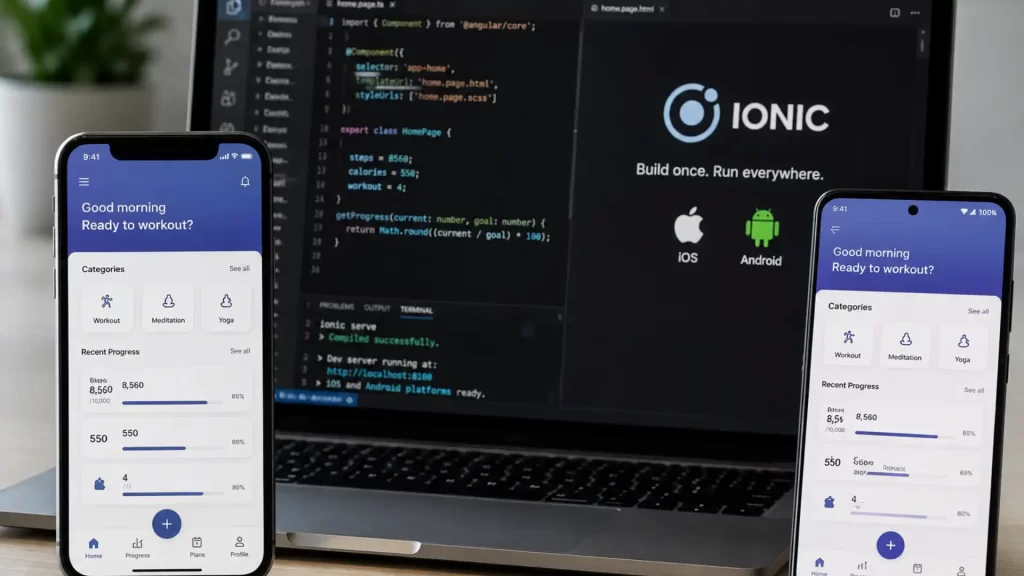
Ionic is an open-source framework for building mobile applications using web technologies — HTML, CSS, and JavaScript. Rather than writing separate codebases for iOS and Android, you write one application and deploy it to both platforms. Ionic apps run inside a native shell — a thin wrapper that makes the app behave like a native one from the user’s perspective.
The key component that makes this possible is Capacitor, Ionic’s native runtime. Capacitor acts as a bridge between your web-based application and the device’s hardware, giving the app access to features like the camera, GPS, biometrics, push notifications, and the file system — the kinds of things users expect from a proper mobile app.
This approach is what sits at the heart of hybrid app development: one codebase, multiple deployment targets, with access to native device features through a structured plugin system. Ionic is one of the most mature and widely adopted frameworks for doing this.
Why businesses choose Ionic app development
The appeal of Ionic for businesses comes down to a straightforward set of practical advantages. It is not about being the most powerful framework on the market — it is about delivering solid, maintainable apps without the cost and complexity of building twice.
One codebase for iOS and Android
This is the headline benefit of hybrid app development, and it is a significant one. Building separate native apps — one in Swift for iOS and one in Kotlin for Android — effectively doubles your development effort, your testing overhead, and your ongoing maintenance burden. With Ionic, you build and maintain a single codebase that deploys to both platforms and, in most cases, to the web as well.
For a business launching an MVP, rolling out an internal tool, or working within a defined budget, that efficiency is not a minor detail. It is often the deciding factor.
Speed to market
Ionic projects move quickly. The development stack — typically Angular, React, or Vue alongside Ionic’s component library — is familiar to a large pool of web developers. That means less time spent on specialist hiring, and faster iteration once the project is underway.
For businesses that need to test an idea in the market before committing to a full native build, the ability to move from concept to working app in weeks rather than months is genuinely valuable.
Lower development and maintenance cost
A single shared codebase naturally reduces cost. You are paying for one development team working on one codebase, not two parallel tracks of work. Updates and bug fixes are applied once and pushed to both platforms simultaneously, which reduces the long-term maintenance cost as well as the initial build.
This cost efficiency is one reason why around 70% of businesses are now adopting hybrid approaches to building mobile apps, according to the hybrid development market. For businesses that need to build custom mobile applications without stretching budgets across separate native projects, the case is clear.
What Ionic is genuinely good at in 2026
Ionic performs best for a clear category of business applications. Understanding that category helps you decide quickly whether it is the right fit.
- Internal business tools — inventory systems, field service apps, reporting dashboards, and similar operational software that needs to work on multiple devices and update frequently
- Customer-facing apps that rely on APIs and backend data — booking platforms, loyalty apps, e-commerce apps, client portals
- MVPs and proof-of-concept builds where speed to market matters more than peak performance
- Projects where the team has strong web development skills but limited native mobile experience
- Apps that need to be deployed to iOS, Android, and a web browser from a single build
These use cases represent a large proportion of the mobile app projects businesses actually need. If your app falls into one of these categories, Ionic is not a compromise — it is a sensible choice.
Where Ionic has real limitations
Choosing Ionic honestly means acknowledging where it is not the best tool. There are genuine scenarios where a native build or an alternative cross-platform framework is the stronger choice.
Graphics-heavy and real-time applications
If your app requires complex real-time rendering, heavy animations, or processing-intensive graphics — think AR features, 3D interfaces, or intensive gaming — native development will give you better results. Ionic apps run inside a WebView, and while Capacitor bridges to native device features, it cannot match the raw GPU access that native code provides for demanding visual tasks.
Apps requiring deep platform-specific integrations
Some mobile projects need to integrate deeply with iOS- or Android-specific APIs that are not fully exposed through Capacitor’s plugin ecosystem. If your app depends on highly specialised hardware interactions or platform-specific behaviour at a low level, a native build may be unavoidable.
When performance benchmarks are critical
For the vast majority of business apps, Ionic’s performance is entirely adequate. Users will not notice the difference. But if your app will be benchmarked against frame rates or response times — or if it processes large volumes of data locally on the device — native frameworks or Flutter may offer a measurable edge.
The honest position is this: for most business applications, these limitations do not apply. But knowing where they sit helps you make the right call when they do.
Ionic framework vs Flutter vs React Native in 2026
The Ionic framework is not the only option in the hybrid and cross-platform space, so it is worth being clear about how it sits alongside the main alternatives.
Ionic vs Flutter
Flutter, backed by Google and built on the Dart language, compiles directly to native code and produces apps with high-performance, visually rich interfaces. It is an excellent choice when UI quality and animation performance are priorities. The trade-off is that Flutter uses Dart — a language most web developers do not already know — which increases the learning curve and narrows the talent pool. Ionic uses web technologies, which most development teams already work with daily.
For businesses choosing between the two, the question is often: do you need Flutter’s visual performance ceiling, or does Ionic’s web-technology familiarity and faster iteration suit your project better?
Ionic vs React Native
React Native, built by Meta, is another popular cross-platform option that renders closer to native UI components than Ionic does. It has a large community and a mature ecosystem. However, it is also more complex to maintain, and its bridge architecture has historically introduced performance overhead that requires careful management.
The Ionic framework is often a more straightforward choice for teams whose background is in web development and who need to ship quickly. For more complex app requirements, it is worth discussing the options with a team that has experience across frameworks — which is something our mobile app development service covers directly.
What types of businesses get the most from Ionic app development
Ionic is not a universal solution, but there is a clear profile of businesses that consistently get strong results from it.
- SMEs and growing businesses building their first mobile app, where budget efficiency and time to market are important
- Businesses with existing web development teams who want to extend into mobile without learning an entirely new stack
- Organisations running internal tools and operational apps that need to work across both iOS and Android devices
- Startups building MVPs who need a working, deployable product quickly and can optimise later based on real user feedback
- Businesses that need a single app deployable to iOS, Android, and the web simultaneously
If your business fits any of these descriptions, Ionic is worth serious consideration. The framework is actively maintained, the community is substantial, and the ecosystem of Capacitor plugins covers the device features that most real-world apps need.
How Ionic app development fits into your broader digital setup
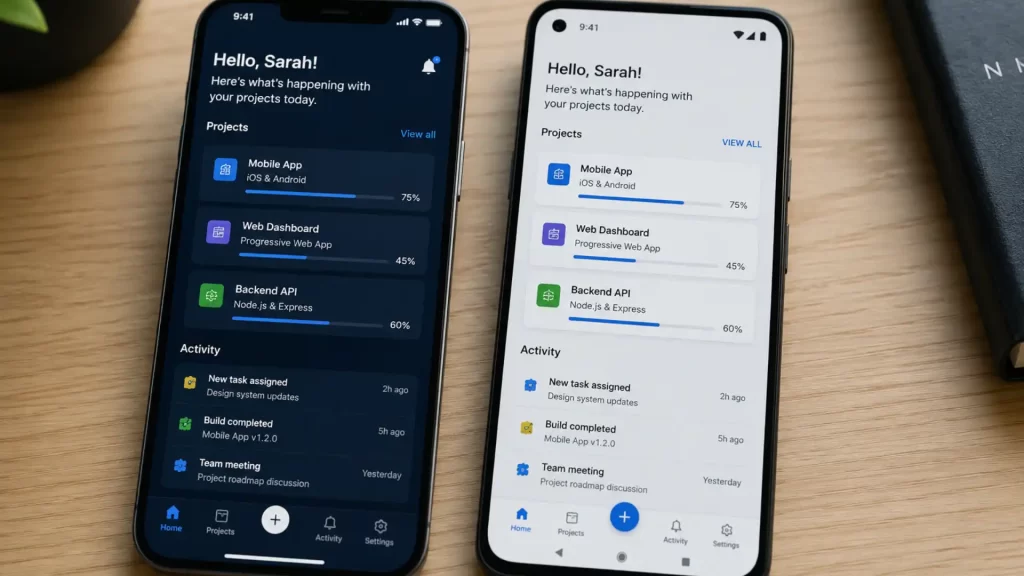
A mobile app rarely exists in isolation. In most business contexts, it connects to a website, a CRM, a booking system, or some form of backend data management. One of Ionic’s practical strengths is how naturally it integrates with existing digital infrastructure.
Because Ionic apps are built with standard web technologies, they connect cleanly to APIs, web services, and third-party platforms. If you are also running automations or workflows in your business — through tools like CRMs or connected systems — an Ionic app can surface and interact with that data on mobile. This is particularly useful for businesses exploring AI automation and connected workflows, where mobile access to live business data is valuable.
It is also worth noting that Ionic apps can be deployed as progressive web apps (PWAs) in addition to native stores, which means users can access the same application through a browser without needing to download anything. For businesses with audiences across different platforms and devices, that flexibility adds genuine reach.
From a wider digital perspective, your mobile app works best when it sits alongside a website built with the same goals in mind. A strong conversion-focused web design ensures that users moving between your app and your website have a consistent, professional experience — and that both channels are working together to support your business.
So is Ionic app development still a smart choice in 2026?
The short answer is yes — for the right kind of project. Ionic is not the default answer for every mobile app, but for a wide range of business applications it remains one of the most practical and cost-effective ways to build for mobile.
The Ionic framework has matured significantly. Capacitor has replaced Cordova as the native runtime and is actively developed. The component library covers modern UI patterns. The Angular, React, and Vue integrations mean that web development teams can move into mobile without rebuilding their skills from scratch.
For businesses that need an app that works on iOS, Android, and the web from a single build — delivered within a realistic budget and timeline — Ionic remains a genuinely strong option in 2026. The key is being clear about what you need the app to do, and choosing the framework that fits that brief rather than the one with the most press coverage.
A useful external overview of how JavaScript frameworks fit into the broader mobile development landscape can be found in the Ionic Framework official documentation, which covers the current architecture and Capacitor integration in detail.
Ready to build your mobile app with Ionic?
Whether you are starting from scratch or looking to migrate an existing product to a more maintainable cross-platform approach, the right planning makes a significant difference. The Webphoria team builds mobile apps for growing UK businesses, and we will give you a clear picture of what Ionic can deliver for your specific project — without the jargon.
Get in touch and we will help you map out the right approach from the start.