
When to use voice AI and when to use a human
When to use voice AI and when to use a human
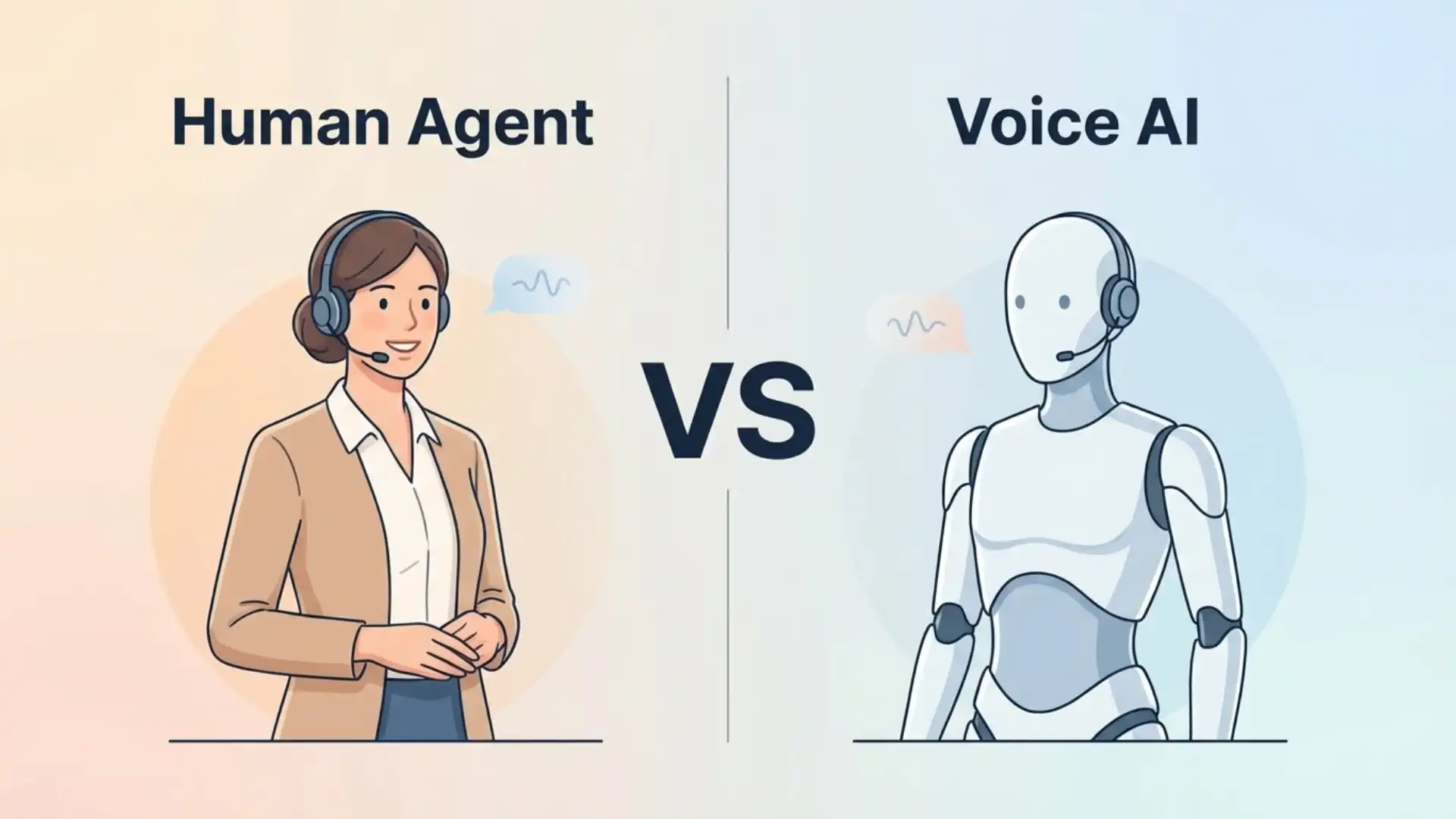
The voice AI vs human agent decision sounds straightforward until you get it wrong. Deploy AI too broadly and customers who needed empathy get a system that cannot read the room. Rely entirely on human agents and you burn staff time on calls that a well-configured AI could have handled in seconds. Neither extreme works. What works is understanding the difference between the two well enough to deploy each one exactly where it belongs — and that is what this guide is about.
For UK businesses managing inbound calls, enquiries, and customer communication, AI customer service automation has moved from experiment to expectation. The technology is genuinely capable. But capable does not mean appropriate in every situation. This guide takes a scenario-led approach to the voice AI vs human agent question — looking at the specific types of interaction where each one genuinely excels, where the costs of getting it wrong are highest, and how to design a system that uses both intelligently.
Why the voice AI vs human agent question matters more than you think
Most businesses approach the voice AI vs human agent question as a cost question. Can we reduce staffing costs by automating more calls? That framing is not wrong — an AI voice agent for business does reduce cost per interaction significantly — but it is incomplete. The more important question is what it costs when you get the deployment wrong.
A caller who reaches an AI system in the middle of a complaint, a bereavement claim, or a genuinely urgent problem and cannot get to a human in time will not quietly accept it. They will remember it. They will tell people about it. And in a business environment where customer retention depends on trust, a single badly-handled call can undo the value of a much larger marketing spend.
The businesses that benefit most from AI customer service automation are not the ones that automate the most. They are the ones that automate the right interactions — and leave the wrong ones firmly in human hands. Understanding that boundary is the entire challenge, and it is more nuanced than most people expect.
Four interaction types — and where AI voice agent for business fits
Not all customer interactions are created equal. The most useful way to think about the voice AI vs human agent question is to classify every interaction your business handles by type, and then map each type to the appropriate resource. Here is a framework that works across most UK businesses.
Type 1: Routine and rule-based
These are the interactions that follow a predictable path from start to finish: appointment reminders, order status updates, account balance checks, FAQ responses, opening hours, and basic booking confirmations. There are no judgement calls involved, no emotional complexity, and no exceptions to handle.
This is where voice AI vs human agent is not really a debate — AI wins clearly. An AI voice agent for business handles this category at scale, around the clock, with zero fatigue and zero marginal cost per call. Routing these interactions to human agents wastes skilled staff on work that does not need them.
Type 2: Complex but not emotional
These are interactions that require real information, multi-step logic, or access to account history — but where the caller is not distressed and the outcome is factual rather than relational. Examples include technical troubleshooting that follows a diagnostic tree, billing queries that require pulling account data, and product or service comparisons.
Advanced AI customer service automation handles a significant proportion of Type 2 calls well — particularly when the AI is connected to CRM data and can pull relevant account context in real time. However, this is also where AI hits its ceiling fastest. When a caller’s situation does not fit the expected path, when they need a judgement call, or when multiple issues are intertwined, human agents resolve the call more reliably and in less total time.
Type 3: Emotional and high-stakes
This is the category where the voice AI vs human agent question has only one answer: human. Complaints, escalations, distressed callers, sensitive personal situations, bereavement, health, and safeguarding — these are not just categories where AI performs less well. They are categories where deploying AI first represents a genuine failure of customer care.
AI can detect some emotional signals — unusual phrasing, rising urgency, repeated questions — but it cannot respond to emotion. It cannot lower its voice, slow its pace, acknowledge what a caller is actually going through, or adapt in the moment to a situation it was not trained to anticipate. When a caller is upset and receives a synthetic voice that stays calm and on-script, the effect is often the opposite of reassuring. It confirms that nobody is listening.
AI customer service automation deployed in this category without a clear and immediate route to a human is one of the most reliable ways to permanently damage a customer relationship. The rule is simple: if there is any possibility that the caller is distressed, route to human from the start.
Type 4: High-value and relationship-driven
Long-standing clients, VIP customers, and enterprise accounts represent a disproportionate share of revenue for most businesses. For these callers, the voice AI vs human agent question is not primarily about call type — it is about the message your routing decision sends. Sending a high-value client to an AI system for triage signals that their call is being handled like everyone else’s, which for many clients is not the message you want to send.
This does not mean AI has no role here. AI can handle the triage and information-gathering phase before transferring to a named human contact with full context already captured. But the human element needs to be present, prominent, and prompt. Clients who feel they can always reach a person quickly are clients who stay.
What good handoff looks like in a voice AI vs human system
The weakest point in most hybrid voice AI vs human agent setups is not the AI itself — it is the transition. A caller who has already spoken to an AI system and then has to repeat everything to a human agent has not had their time saved. They have had it wasted twice. Getting the handoff right is as important as getting the routing right.
A well-designed handoff has three characteristics:
- Context transfers completely: the human agent receives everything the AI captured — caller identity, account details, the issue raised, and any history from the current call — before they pick up. The caller does not repeat themselves.
- The transition is fast: the gap between AI and human should be seconds, not minutes. A caller who waits in a queue after being promised a human transfer loses confidence in the system rapidly.
- The escalation is frictionless: the caller should be able to reach a human at any point by expressing that they want one. A voice AI system that loops a caller back into automation when they have already asked for a person creates the kind of frustration that ends relationships.
Designing a voice AI vs human agent system with these handoff principles built in requires thinking about the technology, the workflow, and the human processes together — not separately. The AI component and the human team need to be connected through a shared system so that context does not disappear at the point of transfer.

The real strengths of AI customer service automation
Within its appropriate scope, the voice AI vs human agent comparison is not close. AI customer service automation delivers advantages that human teams structurally cannot match, and understanding those advantages clearly is what allows you to make the most of them without over-extending into territory where AI does not belong.
- Always available: AI answers every call immediately, at any hour, on any day. No queues, no voicemail, no missed calls after hours. For businesses where out-of-hours contact is common, this is transformative.
- Infinitely scalable: ten calls and ten thousand calls cost the same to handle. Human teams are constrained by headcount; AI customer service automation is not. Seasonal spikes, campaigns, and high-volume periods are absorbed without additional staffing.
- Perfectly consistent: every caller receives exactly the same information, phrased the same way, with no variance in tone or accuracy across agents or shifts. In regulated industries, this consistency is not just convenient — it is essential.
- Cost-efficient at volume: the per-call cost of AI is a fraction of the per-call cost of a skilled human agent. For high-volume, low-complexity interactions, the financial case is strong and the quality trade-off is minimal.
- Effective triage: AI collects caller details, categorises the call type, and presents a prepared brief to the human agent before the transfer. The human starts the conversation informed — which shortens resolution times and reduces caller frustration.
What human agents do that voice AI cannot replicate
For all that AI customer service automation can do within the right boundaries, the human voice carries something that cannot currently be programmed: the capacity to respond to a person as a person. The voice reveals emotion — not just in what is said, but in pace, tone, hesitation, and emphasis — and a skilled human agent reads and responds to all of it in real time.
When a caller is angry, a human agent can acknowledge that anger without script. When a caller is confused, a human can rephrase, reframe, and adapt until understanding is reached. When a situation is genuinely without precedent, a human can exercise judgement, make a decision, and take ownership of the outcome. These are not refinements on AI’s existing capabilities — they are different things entirely.
The voice AI vs human agent question is sometimes framed as a temporary one — as though AI will eventually be good enough to handle everything a human can. That framing misunderstands what emotional intelligence actually is. It is not a set of rules that can be encoded. It is the product of lived experience, embodied awareness, and the kind of contextual understanding that emerges from being the same kind of thing as the person on the other end of the line. An AI voice agent for business can do a great deal. But it cannot be a person. And for a significant proportion of the interactions that matter most to your customers, being a person is the entire point.
Building a connected system around AI customer service automation
The most effective voice AI vs human agent implementations are not built on standalone AI systems. They are built on connected platforms where voice AI, CRM data, chatbots, messaging tools, and human workflows all share the same information and operate as a single coherent system.
When your AI voice agent is connected to your CRM, it can greet returning callers by name, pull their account history, and route them based on their tier or recent activity. When it is connected to your ticketing or case management system, the handoff to a human agent carries the full context of the interaction. When it is integrated with your messaging tools — WhatsApp, email, or live chat — it can offer callers an alternative channel mid-call if that serves them better.
This kind of connected infrastructure is exactly what separates AI customer service automation that genuinely works from AI that merely answers calls. The AI component is only as useful as the systems it is connected to. Building those connections — designing the integrations, the workflows, and the routing logic that tie everything together — is where the real value is created. If you are looking at how AI voice, chatbots, CRM automation, and digital communication tools can work together for your specific business, Webphoria’s full range of digital and automation services covers exactly this kind of connected system design — built around how your business actually operates, not around off-the-shelf templates.
Getting the voice AI vs human agent balance right for your business
The answer to the voice AI vs human agent question is not the same for every business or every interaction type. It is a decision that requires you to look at your actual contact patterns, understand which interactions carry the most risk if mishandled, and design a system that routes each type to the resource best equipped to handle it.
AI customer service automation works. A skilled AI voice agent for business handles high-volume, rule-based, out-of-hours calls efficiently and consistently. But the moment a caller needs to feel heard — really heard — the voice AI vs human agent decision has already been made for you. Build the system that knows the difference, design the handoff that works when it matters, and give your human team the space to do what only humans can do. That combination, built thoughtfully, is what strong customer communication actually looks like.
Not sure whether to use voice AI or human agents in your business?
Using AI in the wrong situations can frustrate customers, while relying only on human agents can limit scale and increase costs. The key is knowing which interactions to automate and when to involve a real person. We help businesses design connected systems that combine voice AI, chatbots, and human support to improve response times, reduce costs, and deliver a better customer experience.