
Why your Google Business Profile is your most powerful local SEO tool
Why your Google Business Profile is your most powerful local SEO tool
Your Google Business Profile local SEO performance has a direct effect on whether local customers can find you — or your competitors — when they search on Google. For any UK business that relies on customers from a specific area, this free listing is not a nice-to-have. It is the most visible and most influential piece of your local digital presence.
And yet, a significant number of businesses either have an unclaimed profile, a half-completed one, or one that has never been actively managed. That is leaving a real opportunity on the table — and handing an advantage to whoever in your local area is taking it more seriously.
This guide explains what a Google Business Profile actually does for your local search rankings, why it matters more now than ever, and what you should be doing with it to make it work properly.
What is a Google Business Profile and why does it matter for local search results?
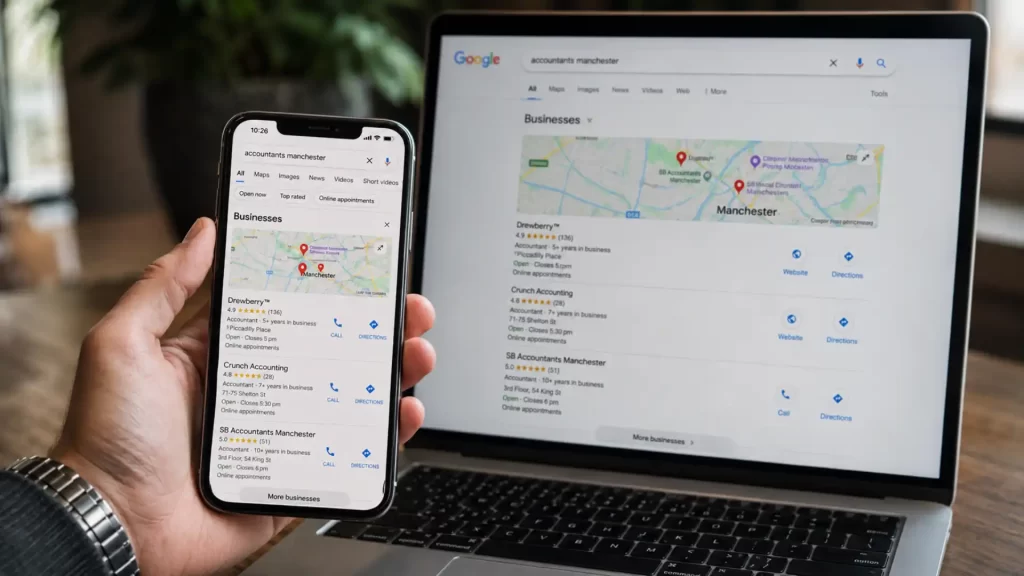
A Google Business Profile (GBP) is a free listing that controls how your business appears in Google Search and Google Maps. When someone searches for a service in a specific area — “web designer near me” or “plumber in Manchester” — Google decides which businesses to show based on a combination of factors. Your profile is at the centre of that decision.
The most prominent position in local search results is known as the Local Pack or Map Pack. This is the block of three business listings that appears at the top of search results for location-based queries, above the standard organic results. Getting into that pack dramatically increases your visibility, because it is the first thing most users see — and a large share of local clicks go to those three listings.
Without a properly set up and optimised profile, your business is far less likely to appear there, regardless of how good your website is. Your Google Business Profile is the primary signal that tells Google where you are, what you do, and whether your business is trustworthy enough to recommend.
The three factors Google uses to rank local businesses
Understanding what Google actually looks at helps you prioritise what to do with your profile. Google evaluates local businesses on three core factors:
- Relevance — how closely your business matches what the person is searching for. This is shaped by your business category, services listed, and the keywords in your profile description.
- Distance — how far your business is from the searcher, or from the location they specified in the query.
- Prominence — how well-established and reputable your business appears to be, based on reviews, the consistency of your business information online, and the overall strength of your web presence.
You have direct control over relevance through the information you add to your profile. Distance is fixed by your location. But prominence — which is where most businesses either win or lose the Local Pack — is built through active, ongoing profile management: generating reviews, keeping information current, posting regular updates, and maintaining consistent business details across the web.
How to optimise your Google Business Profile for local SEO
Setting up a profile is step one. Optimising it is an entirely different task — and the gap between a basic listing and a properly optimised one is significant in terms of how it performs in local search results.
Complete every section of your profile
Google uses the information you provide to match your business with relevant searches. Incomplete profiles give Google less to work with, which means fewer matches and lower visibility. Every field matters: business name, category, address, phone number, website, opening hours, service areas, services, and the business description.
Your business description is worth taking seriously. It is indexed by Google and is one of the places where you can naturally include the keywords that reflect what you actually do. Keep it factual, clear and written for the customer — not stuffed with keywords, but genuinely informative.
Choose the right primary category
Your primary business category is one of the strongest signals in your profile. Google uses it to determine when to show your listing. Choose the most specific, accurate category for what your business actually does. If you design and build websites, “Web design company” is more targeted than “Internet company”. You can add secondary categories too, which broadens the range of searches you can appear for.
Add photos regularly
Profiles with photos consistently get more clicks and more directions requests than those without. Add high-quality images of your work, your team, and your premises. Update them regularly — an active, recently updated profile signals to Google that your business is current and engaged, which contributes positively to your Google Maps ranking.
Reviews: the most underused part of your local SEO strategy
Reviews are one of the most influential factors in both Google Maps ranking and customer decision-making. Businesses with a higher volume of recent, positive reviews consistently outperform those with fewer, older reviews — even when other profile elements are comparable.
The key things to focus on are quantity, recency and responses. A business with 200 reviews that stopped accumulating them 18 months ago will typically underperform against one with 80 reviews that has been getting new ones steadily. Google treats recent engagement as a freshness signal.
Responding to reviews — positive and negative — also matters. It shows both Google and potential customers that your business is active and takes customer feedback seriously. A professional, considered response to a negative review often does more to build trust than a positive review does on its own.
How to generate more Google reviews
- Ask every customer — most people will leave a review if you ask them directly, but very few will do it unprompted.
- Make it easy — give them a direct link to your review page, not directions to find it themselves.
- Follow up by email or message after a job is complete — a short, friendly prompt with a link is enough.
- Respond to every review — it encourages others to leave them when they see the business is engaged.
Consistency across the web: why it matters for local rankings
Google uses your Google Business Profile information as a reference point — and then looks across the web to check whether other sources agree. If your business name, address and phone number appear differently on your website, on directories, or on social profiles, those inconsistencies create doubt in Google’s systems.
This is called NAP consistency (Name, Address, Phone number). It is not complicated to manage, but it does require a methodical check across the places your business is listed. The most commonly used directories in the UK include Yelp, Yell, Bing Places, Thomson Local, and industry-specific platforms relevant to your sector.
Even small variations — “St” versus “Street”, or a slightly different phone number format — can be enough to dilute the confidence signals that support your Google Business Profile local SEO performance. Getting this consistent across the main platforms is a straightforward task that pays dividends in ranking stability.
How your website and your Google Business Profile work together
Your profile does not operate in isolation. Google looks at the quality and relevance of your website as part of assessing your prominence in local search results. A well-built, fast, clearly structured website reinforces the signals your profile sends — and a poorly performing one undermines them.
Specifically, your website should:
- Clearly reference the geographic areas you serve, in page content and ideally in dedicated location pages for businesses covering multiple areas
- Load quickly on mobile — the majority of local searches happen on mobile devices, and slow load times increase bounce rates and damage rankings
- Include your business name, address and phone number in a consistent format, matching exactly what is on your Google Business Profile
- Contain locally relevant content that demonstrates expertise in your area and sector
This connection between your site and your profile is why strong local SEO is always a joined-up effort. If you are investing time in your Google Business Profile but your website is working against you, the results will be limited. Our conversion-focused web design services are built around exactly this — websites that support your visibility, not hinder it.
Posts, Q&A and other active profile features you should be using
Your Google Business Profile includes several features beyond the basic listing that contribute to both Google Maps ranking and customer engagement — and most businesses ignore them entirely.
Google Posts
Google Posts allow you to publish short updates directly to your profile, much like a social media post. They appear in your listing and can include text, images and links. Posting regularly signals to Google that your business is active. Use them to highlight services, share recent work, announce updates, or simply demonstrate expertise in your field. Posts are indexed and searchable, which means they can contribute to your Google Business Profile local SEO beyond your main listing.
Questions and answers
The Q&A section allows anyone to ask questions about your business, and anyone can answer them — including you. Many businesses do not monitor this section, which means customers can ask questions and get no response, or get incorrect answers from other users. Check it regularly, answer questions promptly, and consider seeding it with common questions and clear answers yourself.
Products and services
Adding detailed products and services to your profile gives Google more information to match your listing with specific searches. It also makes your listing more useful to customers evaluating whether you offer what they need before they even click through to your site.
For businesses running AI-powered systems and automations, it is also worth noting that AI automation tools can help streamline review collection and customer follow-up processes — connecting the operational side of your business with your digital marketing activity.
How to track whether your Google Business Profile is actually working
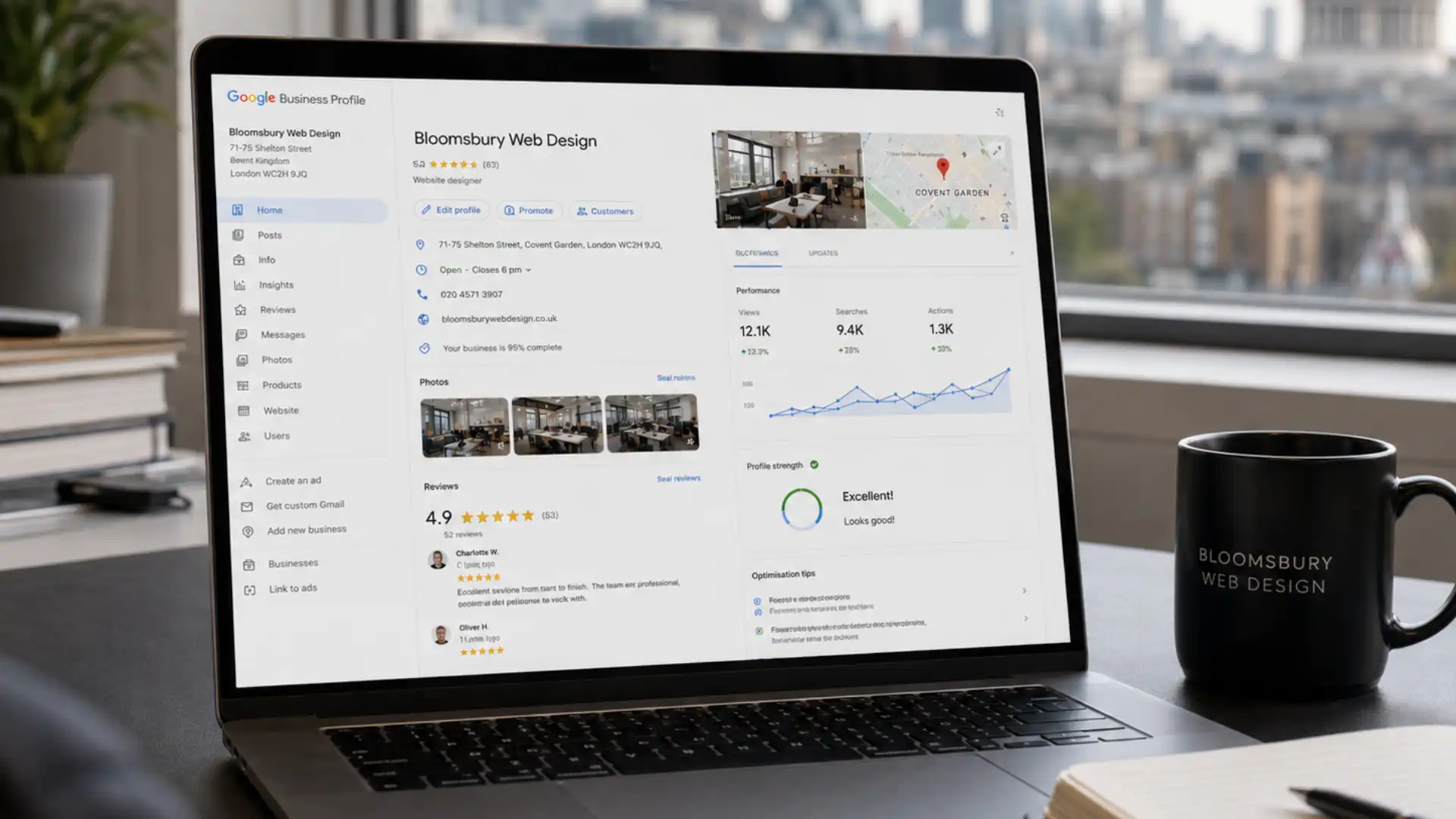
Google provides performance data directly within your profile. You can see how many times your listing appeared in search, how many people clicked for directions, how many called from the listing, and how many visited your website. This data tells you whether your profile is generating real activity — not just impressions, but actual customer actions.
Look at these metrics over time rather than in isolation. What matters is the trend: are calls and direction requests increasing month on month? Is your profile appearing in more searches? If the numbers are static or declining, it is a signal that your profile needs attention — more reviews, fresher posts, more complete information, or a review of your categories.
Google’s official support documentation for Business Profiles is regularly updated and worth consulting as a reference point for current best practice. You can access it at Google Business Profile Help.
Ready to improve your local visibility and get found by more local customers?
Your Google Business Profile local SEO performance is one of the highest-return areas of your digital presence — and it is free to improve. Whether your profile needs setting up properly, your reviews need a strategy, or your website needs to be working with your profile rather than against it, we can help you work out where to focus.
We build websites for UK businesses that are designed to convert and to support your wider digital visibility — including your local search results performance. Let us take a look at what you are working with.