
Facebook ads vs Google ads – which is more cost effective?
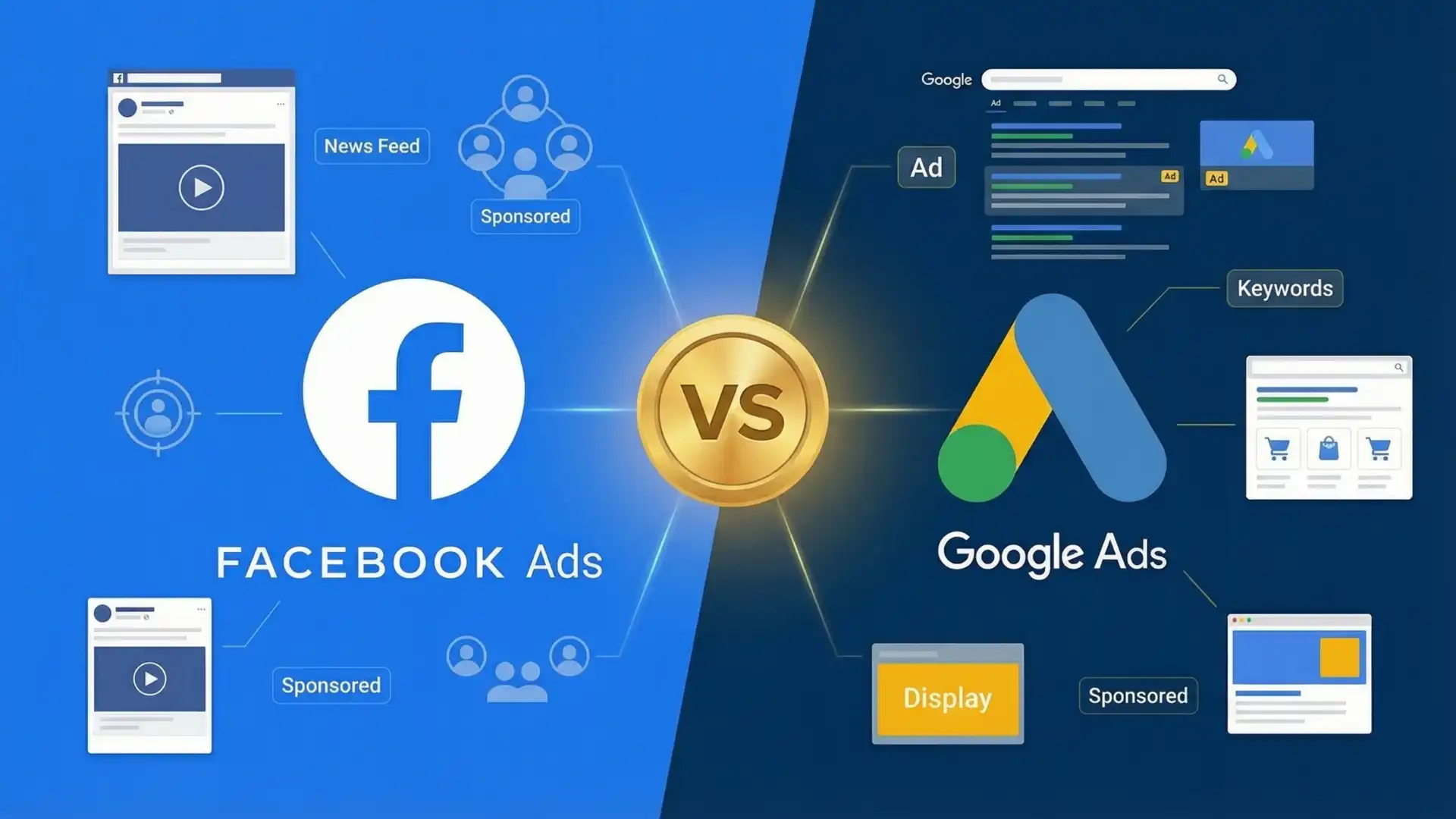
Facebook ads vs Google ads – which is more cost effective?
Facebook ads vs Google ads — it’s one of the most common questions business owners ask when planning their digital marketing budget. Both platforms are powerful, both can drive real results, and both cost money. But they work in very different ways, and choosing the wrong one for your goals could mean spending more than you need to.
This guide breaks down how the two platforms compare on cost, targeting, and return on investment — so you can make a smarter decision about where to put your budget.
The key difference between the two platforms
Before comparing costs, it helps to understand what each platform actually does — because they serve very different purposes in the buying journey.
Google Ads is a search-based platform. When someone types “web designer near me” or “best accountant in Manchester” into Google, your ad can appear at the top of the results. You’re reaching people who are already looking for what you offer. That’s high intent — and it’s why Google Ads tends to convert well.
Facebook Ads works differently. Users aren’t searching for anything — they’re scrolling through their feed. Your ad interrupts that experience and creates interest where none existed before. This is what marketers call demand creation, rather than demand capture.
Neither approach is better in absolute terms. The right choice depends entirely on your business, your audience, and what you’re trying to achieve.
Cost per click: what you can expect to pay
When businesses compare Facebook ads vs Google ads, cost per click (CPC) is usually the first metric they look at — and the gap is significant.
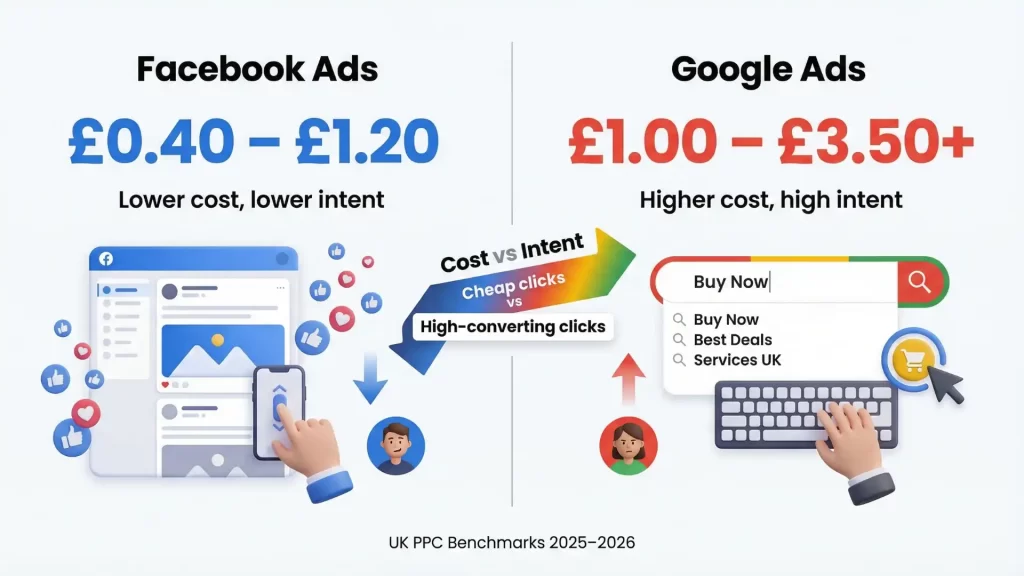
Facebook ads cost per click is considerably lower on average. Across industries, businesses in the UK typically pay around £0.25–£0.50 per click on Facebook, making it one of the more affordable ways to drive traffic. Google ads cost per click, by contrast, tends to run much higher — often £1.00–£5.00 or more depending on how competitive the industry is. Legal, financial, and healthcare sectors are particularly expensive on Google, where fierce competition pushes up bids.
According to industry benchmarks from WordStream, the average CPC on Facebook sits around $0.49 globally, compared to $2.29 for Google Search. That’s a meaningful difference in raw click cost — but cost per click alone doesn’t tell the full story.
Why a cheaper click isn’t always a better deal
A lower Facebook ads cost per click sounds appealing, but the quality of that click matters. A Google user who searches “buy running shoes online” is far further along in their decision-making than someone who sees your trainer ad while scrolling Instagram. Google clicks tend to convert at a higher rate precisely because the intent is already there.
For most businesses, Google ads cost per click is higher because you’re paying a premium for that intent. In competitive sectors, that premium is absolutely worth it.
Which platform offers better ROI?
Return on investment is ultimately what matters — and this is where the comparison becomes more nuanced. Both platforms can deliver strong ROI when set up correctly, but they do so in different ways.
Well-managed Facebook campaigns typically achieve a return on ad spend (ROAS) of around 3:1 to 5:1. Facebook excels at visual product discovery, building brand awareness, and running retargeting campaigns that bring back people who’ve already shown interest. For e-commerce businesses with appealing products, Facebook is often an extremely cost-effective platform.
Google Ads delivers a median ROAS of around 3.5:1, with stronger performance in industries where people actively search before buying. Local service businesses — plumbers, solicitors, dentists, estate agents — often see excellent ROI from Google because search intent directly signals a need.
It’s also worth factoring in the full cost of customer acquisition, not just the click. A cheaper Facebook lead that requires weeks of nurturing may ultimately cost more than a higher-intent Google lead that converts quickly. The platform that offers better ROI for your business depends on your sales cycle, your margins, and how well your offer converts. If you’d like an honest assessment of which advertising approach suits your business, our portfolio of work across different sectors gives a sense of the kinds of businesses we help and how we approach digital growth.
Targeting: where Facebook has a clear advantage
When it comes to audience targeting, Facebook is the more powerful tool. It holds a vast amount of data on its users — interests, behaviours, demographics, life events, and more — and lets advertisers use all of it.
Want to reach women aged 30–45 in Birmingham who are interested in home interiors and have recently moved house? Facebook can do that. Want to build a lookalike audience based on your existing customers? Facebook can do that too.
Google targets based on what people are actively searching for. This makes it excellent for capturing existing demand, but it’s a blunter tool for reaching people earlier in their journey.
If your product is relatively new, niche, or doesn’t yet have people searching for it, Facebook’s interest-based targeting gives you a way in. If people are already searching for your product or service category, Google puts you in front of them at exactly the right moment.
Which works better for small budgets?
Budget is often the deciding factor for smaller businesses, and here Facebook has a practical edge. You can start running Facebook campaigns for as little as a few pounds per day and still reach a meaningful local audience. This makes it accessible for businesses that are just starting to experiment with paid advertising.
Google Ads generally requires a higher minimum spend to be competitive, particularly in industries where the Google ads cost per click is elevated. In some sectors, a budget that would run a solid Facebook campaign for a month might only buy a handful of Google clicks.
That said, even a modest Google budget can work well if it’s focused on the right keywords. A well-built, tight campaign targeting low-competition terms can generate enquiries at a reasonable cost. If you’re not sure how to structure this, the way your website is built and designed can make a significant difference to how well those clicks convert — something worth considering alongside your ad spend. Our web design service is built around exactly that: turning visitors into customers.
Industry-by-industry: which platform tends to win?
The answer varies considerably by sector. Here’s a rough guide based on how businesses typically perform on each platform:
- E-commerce: Facebook often wins for product discovery and impulse purchases, particularly when the product photographs well. Google Shopping campaigns are effective for capturing people who are actively searching to buy.
- Local services (trades, legal, dental, healthcare): Google Ads tends to deliver stronger results because people search when they have an immediate need. A plumber doesn’t need Facebook awareness — they need to appear when someone types “emergency plumber” into Google.
- B2B businesses: Both platforms play a role. Google captures active searchers; Facebook can be used to build brand awareness and run retargeting campaigns at a lower Facebook ads cost per click.
- New or innovative products: If nobody’s searching for what you sell yet, Facebook is often the better starting point. You’re creating demand, not capturing it.
- Hospitality and lifestyle brands: Facebook and Instagram tend to perform well here because visual storytelling and audience targeting align with how people discover these businesses.
The case for using both together
The most effective digital advertising strategies don’t treat Facebook ads vs Google ads as an either/or question. They use both platforms to cover different stages of the customer journey.
A typical approach: run Facebook campaigns to build awareness and bring people to your website. Then use Google remarketing or branded search to recapture those visitors when they’re ready to act. Used this way, each platform reinforces the other.
For example, someone might see your Facebook ad for a new service you offer, click through to your website, and browse without converting. Three days later, they search for that service on Google — and your ad appears again. That second touchpoint often seals the deal. This also ties in with building trust signals like Google reviews for your business, which can reinforce credibility when someone looks you up after seeing your ad.
Budget allocation between the two depends on your objectives. A new brand with limited search volume might do 70% Facebook and 30% Google. An established business in a competitive search category might flip those numbers. The key is to monitor performance data and adjust over time.
Practical tips for keeping costs down
Whichever platform you choose, there are ways to make your budget go further:
- On Google, use exact match and phrase match keywords rather than broad match to avoid paying for irrelevant clicks. Review your search term reports regularly and add negative keywords to cut wasted spend.
- On Facebook, refresh your creative regularly. Ad fatigue — where the same audience sees the same ad too often — drives up costs and reduces effectiveness. New images and copy reset this.
- Set up retargeting on both platforms. Audiences who’ve already visited your website are warmer and typically cost less to convert.
- On Facebook, build lookalike audiences from your existing customer list. This lets the algorithm find people similar to those who’ve already bought from you.
- On Google, a well-designed landing page that matches your ad message will improve your Quality Score — which directly reduces your cost per click.
Your website plays a central role in all of this. A slow, hard-to-navigate site will waste clicks regardless of how well your ads perform. The same applies to your broader online presence — a strong, consistent brand makes paid advertising work harder. That’s something our branding and logo design service is designed to support.
So, which should you choose?
There’s no single answer to the Facebook ads vs Google ads question — and anyone who tells you otherwise without knowing your business isn’t giving you useful advice.
If people are actively searching for what you sell, start with Google. If you need to build awareness, reach a specific audience, or your product requires more explanation before someone will buy, Facebook is likely the better entry point. For most established businesses with a reasonable budget, using both in a coordinated way will deliver the best results.
If you’re trying to work out the right approach for your business, we’re happy to talk it through. Get in touch with the Webphoria team and we can help you think through a strategy that makes sense for your goals and your budget.
Not sure whether to invest in Facebook ads or Google ads?
Choosing the right platform can make a significant difference to your marketing costs and results. Facebook ads typically offer lower cost per click, while Google ads capture high-intent searches that convert more quickly.
We help businesses plan and manage digital advertising strategies that balance cost, targeting, and return on investment — so your budget works harder across both platforms.